Ch.20 - Radioactivity and Nuclear Chemistry
Tro - Chemistry: A Molecular Approach 4th Edition
Tro4th EditionChemistry: A Molecular ApproachISBN: 9780134112831당신이 사용하는 게 아니라요?교과서 변경
20장, 문제 42c

Predict a likely mode of decay for each unstable nuclide. c. Fr-202

검증된 단계별 안내
1
Step 1: Identify the atomic number of the nuclide. Francium (Fr) has an atomic number of 87.
Step 2: Compare the atomic number to the 'band of stability'. The band of stability is a region where stable nuclides exist. Nuclides with atomic numbers less than 83 undergo alpha decay or beta decay to reach the band of stability. Nuclides with atomic numbers greater than 83 usually undergo alpha decay.
Step 3: Since Francium (Fr) has an atomic number greater than 83, it is likely to undergo alpha decay.
Step 4: In alpha decay, the unstable nuclide loses an alpha particle, which is equivalent to a helium nucleus (2 protons and 2 neutrons).
Step 5: The atomic number decreases by 2 and the mass number decreases by 4 in alpha decay. So, the new nuclide after the decay of Fr-202 would have an atomic number of 85 and a mass number of 198.

비슷한 문제에 대한 검증된 영상 답변:

이 영상 해법은 위 문제에 도움이 된다고 튜터들이 추천한 것입니다.
영상 길이:
1m
도움이 되었나요?

주요 개념

질문에 올바르게 답하기 위해 반드시 이해해야 하는 핵심 개념들은 다음과 같습니다.

Nuclear Decay

Nuclear decay is the process by which an unstable atomic nucleus loses energy by emitting radiation. This can occur through various modes, including alpha decay, beta decay, and gamma decay, each involving the release of different particles or energy forms. Understanding the type of decay helps predict the resulting nuclide and its stability.
추천 영상:

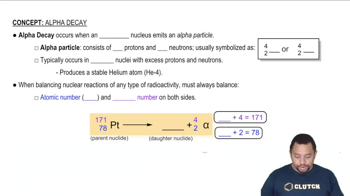
Alpha Decay

Alpha decay is a type of radioactive decay in which an unstable nucleus emits an alpha particle, consisting of two protons and two neutrons. This process decreases the atomic number by two and the mass number by four, resulting in a new element. It typically occurs in heavy elements where the nucleus is too large to be stable.
추천 영상:

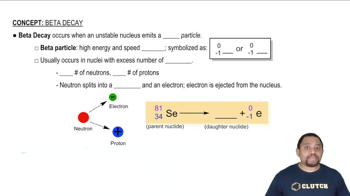
Beta Decay

Beta decay involves the transformation of a neutron into a proton (or vice versa) within the nucleus, accompanied by the emission of a beta particle (an electron or positron). This process changes the atomic number of the nuclide, leading to the formation of a different element. It is common in nuclides that are neutron-rich or proton-rich, respectively.
추천 영상: