Ch.20 - Radioactivity and Nuclear Chemistry
Tro - Chemistry: A Molecular Approach 4th Edition
Tro4th EditionChemistry: A Molecular ApproachISBN: 9780134112831당신이 사용하는 게 아니라요?교과서 변경
20장, 문제 43

Which nuclide in each pair would you expect to have the longer half-life? a. Cs-113 or Cs-125 b. Fe-62 or Fe-70

검증된 단계별 안내
1
Step 1: Understand the concept of half-life. The half-life of a nuclide is the time required for half of the radioactive atoms in a sample to decay. Generally, nuclides with a higher neutron-to-proton ratio or those that are closer to stability tend to have longer half-lives.
Step 2: Analyze the stability of the nuclides. For each pair, compare the neutron-to-proton ratio and how close each nuclide is to the line of stability on the chart of nuclides. Nuclides closer to the line of stability typically have longer half-lives.
Step 3: Compare Cs-113 and Cs-125. Determine the neutron-to-proton ratio for each nuclide. Cs-125 has more neutrons than Cs-113, which might make it more stable and potentially give it a longer half-life.
Step 4: Compare Fe-62 and Fe-70. Again, calculate the neutron-to-proton ratio for each nuclide. Fe-70 has more neutrons than Fe-62, which could make it more stable and possibly result in a longer half-life.
Step 5: Consider the general trend that heavier isotopes (those with more neutrons) often have longer half-lives due to increased stability, but also take into account specific nuclear properties that might affect stability.

비슷한 문제에 대한 검증된 영상 답변:

이 영상 해법은 위 문제에 도움이 된다고 튜터들이 추천한 것입니다.
영상 길이:
1m

주요 개념

질문에 올바르게 답하기 위해 반드시 이해해야 하는 핵심 개념들은 다음과 같습니다.

Half-Life

Half-life is the time required for half of the nuclei in a sample of a radioactive substance to decay. It is a key concept in nuclear chemistry and helps in understanding the stability of nuclides. A longer half-life indicates a more stable nuclide, while a shorter half-life suggests a more unstable one that decays rapidly.
추천 영상:
가이드 코스
02:17
Zero-Order Half-life

Nuclear Stability

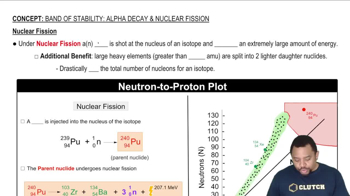
Nuclear stability refers to the tendency of a nucleus to remain intact without undergoing radioactive decay. Factors influencing stability include the ratio of neutrons to protons and the overall binding energy of the nucleus. Generally, nuclides with a balanced neutron-to-proton ratio are more stable and exhibit longer half-lives.
추천 영상:
가이드 코스
03:29
Band of Stability: Nuclear Fission

Isotopes

Isotopes are variants of a particular chemical element that have the same number of protons but different numbers of neutrons. This difference in neutron count can affect the stability and half-life of the isotopes. For example, isotopes of cesium (Cs-113 and Cs-125) and iron (Fe-62 and Fe-70) can exhibit varying half-lives due to their distinct nuclear compositions.
추천 영상: