Ch.21 - Organic Chemistry
Tro - Chemistry: A Molecular Approach 4th Edition
Tro4th EditionChemistry: A Molecular ApproachISBN: 9780134112831당신이 사용하는 게 아니라요?교과서 변경
21장, 문제 103

Explain why carboxylic acids are much stronger acids than alcohols.

검증된 단계별 안내
1
Carboxylic acids and alcohols both contain an -OH group, but the key difference lies in the structure and stability of their conjugate bases.
When a carboxylic acid donates a proton (H+), it forms a carboxylate ion, which is resonance-stabilized. This means the negative charge can be delocalized over two oxygen atoms, making the conjugate base more stable.
In contrast, when an alcohol donates a proton, it forms an alkoxide ion, which lacks resonance stabilization. The negative charge is localized on the oxygen atom, making the conjugate base less stable.
The greater stability of the carboxylate ion compared to the alkoxide ion means that carboxylic acids are more willing to donate a proton, thus making them stronger acids.
Additionally, the presence of the carbonyl group (C=O) in carboxylic acids can further stabilize the conjugate base through inductive effects, enhancing the acid strength compared to alcohols.

주요 개념

질문에 올바르게 답하기 위해 반드시 이해해야 하는 핵심 개념들은 다음과 같습니다.

Acid Strength and Ionization

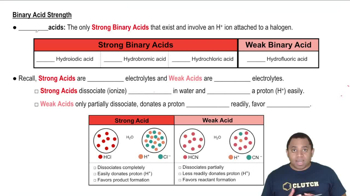
Acid strength is determined by the ability of an acid to donate protons (H+) in solution. Stronger acids ionize more completely, releasing more protons. Carboxylic acids, with their -COOH group, can easily lose a proton to form a carboxylate ion, which is stabilized by resonance, making them stronger acids compared to alcohols, which do not ionize as readily.
추천 영상:
가이드 코스
03:51
Binary Acid Strengths

Resonance Stabilization

Resonance stabilization occurs when a molecule can be represented by multiple valid Lewis structures, distributing charge over several atoms. In carboxylic acids, the carboxylate ion formed after deprotonation can delocalize the negative charge across two oxygen atoms, enhancing stability. In contrast, the alkoxide ion from alcohols lacks this extensive resonance, making it less stable and thus less favorable for proton loss.
추천 영상:
가이드 코스
01:42
Resonance Structures

Electronegativity and Inductive Effects

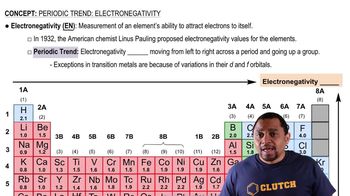
Electronegativity refers to the tendency of an atom to attract electrons. In carboxylic acids, the presence of electronegative oxygen atoms adjacent to the acidic hydrogen enhances the acid's ability to stabilize the negative charge after deprotonation through inductive effects. Alcohols, having only one electronegative oxygen, do not provide the same level of stabilization, resulting in weaker acidity.
추천 영상:
가이드 코스
02:10
Electronegativity Trends