Ch.4 - Chemical Quantities & Aqueous Reactions
Tro - Chemistry: A Molecular Approach 4th Edition
Tro4th EditionChemistry: A Molecular ApproachISBN: 9780134112831당신이 사용하는 게 아니라요?교과서 변경
4장, 문제 92b,c,d

Complete and balance each gas-evolution equation. b. HCl(aq) + KHCO3(aq) → c. HC2H3O2(aq) + NaHSO3(aq) → d. (NH4)2SO4(aq) + Ca(OH)2(aq) →

검증된 단계별 안내
1
Step 1: Identify the reactants and products for each reaction. For reaction b, the reactants are HCl(aq) and KHCO_3(aq). For reaction c, the reactants are HC_2H_3O_2(aq) and NaHSO_3(aq). For reaction d, the reactants are (NH_4)_2SO_4(aq) and Ca(OH)_2(aq).
Step 2: Determine the gas that evolves in each reaction. In reaction b, the reaction between an acid and a bicarbonate typically produces carbon dioxide gas (CO_2). In reaction c, the reaction between an acid and a bisulfite typically produces sulfur dioxide gas (SO_2). In reaction d, the reaction between ammonium sulfate and calcium hydroxide typically produces ammonia gas (NH_3).
Step 3: Write the unbalanced chemical equations including the evolved gases. For reaction b: HCl(aq) + KHCO_3(aq) → KCl(aq) + H_2O(l) + CO_2(g). For reaction c: HC_2H_3O_2(aq) + NaHSO_3(aq) → NaC_2H_3O_2(aq) + H_2O(l) + SO_2(g). For reaction d: (NH_4)_2SO_4(aq) + Ca(OH)_2(aq) → CaSO_4(s) + H_2O(l) + NH_3(g).
Step 4: Balance each chemical equation by ensuring the same number of each type of atom on both sides of the equation. Start by balancing the atoms that appear in the least number of compounds, and then balance the remaining atoms.
Step 5: Verify that each equation is balanced by counting the atoms of each element on both sides of the equation. Ensure that the charges are balanced if the reaction involves ionic species.

주요 개념

질문에 올바르게 답하기 위해 반드시 이해해야 하는 핵심 개념들은 다음과 같습니다.

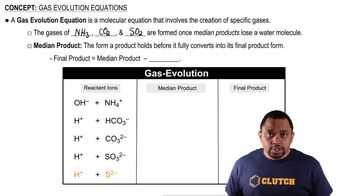
Gas-Evolution Reactions

Gas-evolution reactions are chemical reactions that produce a gas as one of the products. These reactions often involve the combination of an acid with a carbonate or bicarbonate, leading to the release of carbon dioxide. Understanding the nature of these reactions is crucial for predicting the products and balancing the equations correctly.
추천 영상:
가이드 코스
03:35
Gas Evolution Reactions

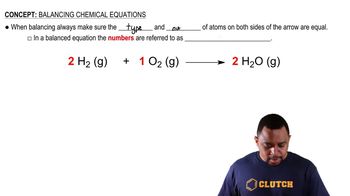
Balancing Chemical Equations

Balancing chemical equations involves ensuring that the number of atoms of each element is the same on both sides of the equation. This is achieved by adjusting the coefficients of the reactants and products. Mastery of this concept is essential for accurately representing the conservation of mass in chemical reactions.
추천 영상:
가이드 코스
01:32
Balancing Chemical Equations

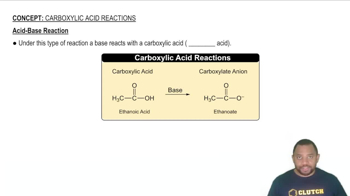
Acid-Base Reactions

Acid-base reactions involve the transfer of protons (H⁺ ions) between reactants. In the context of the given question, acids like HCl and HC₂H₃O₂ react with bases such as KHCO₃ and Ca(OH)₂, leading to the formation of salts and water. Recognizing the roles of acids and bases is vital for predicting the products of these reactions.
추천 영상:
가이드 코스
01:09
Acid-Base Reaction