

Ch.5 - Gases
Tro - Chemistry: A Molecular Approach 4th Edition
Tro4th EditionChemistry: A Molecular ApproachISBN: 9780134112831당신이 사용하는 게 아니라요?교과서 변경
5장, 문제 105

Ammonium carbonate decomposes upon heating according to the balanced equation: (NH4)2CO3(s) → 2 NH3(g) + CO2(g) + H2O(g) Calculate the total volume of gas produced at 22 °C and 1.02 atm by the complete decomposition of 11.83 g of ammonium carbonate.

검증된 단계별 안내
1
Determine the molar mass of ammonium carbonate, \((NH_4)_2CO_3\), by adding the atomic masses of its constituent elements.
Calculate the number of moles of ammonium carbonate using the formula: \(\text{moles} = \frac{\text{mass}}{\text{molar mass}}\).
Use the stoichiometry of the balanced equation to find the total moles of gas produced. According to the equation, 1 mole of \((NH_4)_2CO_3\) produces 2 moles of \(NH_3\), 1 mole of \(CO_2\), and 1 mole of \(H_2O\), totaling 4 moles of gas.
Apply the ideal gas law, \(PV = nRT\), to calculate the total volume of gas. Use \(R = 0.0821 \text{ L atm K}^{-1} \text{ mol}^{-1}\), \(T = 22^\circ C = 295 \text{ K}\), and \(P = 1.02 \text{ atm}\).
Solve for \(V\) in the ideal gas law equation: \(V = \frac{nRT}{P}\), using the total moles of gas calculated in step 3.

비슷한 문제에 대한 검증된 영상 답변:

이 영상 해법은 위 문제에 도움이 된다고 튜터들이 추천한 것입니다.
영상 길이:
4m
도움이 되었나요?

주요 개념

질문에 올바르게 답하기 위해 반드시 이해해야 하는 핵심 개념들은 다음과 같습니다.

Stoichiometry

Stoichiometry is the calculation of reactants and products in chemical reactions based on balanced equations. It allows us to determine the amount of substances consumed and produced in a reaction. In this case, it helps to find out how many moles of gas are generated from the decomposition of ammonium carbonate.
추천 영상:
가이드 코스
01:16
Stoichiometry Concept

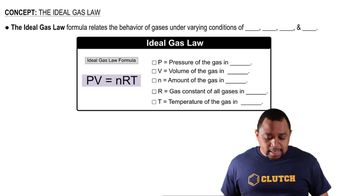
Ideal Gas Law

The Ideal Gas Law relates the pressure, volume, temperature, and number of moles of a gas through the equation PV = nRT. This law is essential for calculating the volume of gases produced in a reaction under specific conditions. In this problem, it will be used to find the total volume of gas produced from the moles calculated from stoichiometry.
추천 영상:
가이드 코스
01:15
Ideal Gas Law Formula

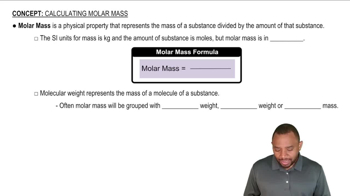
Molar Mass

Molar mass is the mass of one mole of a substance, typically expressed in grams per mole (g/mol). It is crucial for converting between grams of a substance and moles, which is necessary for stoichiometric calculations. For ammonium carbonate, knowing its molar mass allows us to determine how many moles are present in the given mass, facilitating further calculations.
추천 영상:
가이드 코스
02:11
Molar Mass Concept
관련 실천
교과서 질문

Ammonium nitrate decomposes explosively upon heating according to the balanced equation: 2 NH4NO3(s)¡2 N2( g) + O2( g) + 4 H2O( g) Calculate the total volume of gas (at 125 °C and 748 mmHg) produced by the complete decomposition of 1.55 kg of ammonium nitrate.

7866
views
교과서 질문

Consider the reaction:

2 SO2(g) + O2(g) → 2 SO3(g)

a. If 285.5 mL of SO2 reacts with 158.9 mL of O2 (both measured at 315 K and 50.0 mmHg), what is the limiting reactant and the theoretical yield of SO3?

1301
views
교과서 질문

Consider the reaction:

2 SO2(g) + O2(g) → 2 SO3(g)

b. If 187.2 mL of SO3 is collected (measured at 315 K and 50.0 mmHg), what is the percent yield for the reaction?

교과서 질문

Olympic cyclists fill their tires with helium to make them lighter. Calculate the mass of air in an air-filled tire and the mass of helium in a helium-filled tire. Assume that the volume of the tire is 855 mL, that it is filled to a total pressure of 125 psi, and that the temperature is 25 °C. Also, assume an average molar mass for air of 28.8 g/mol. Calculate the mass of helium in a helium-filled tire.

1872
views
교과서 질문

Olympic cyclists fill their tires with helium to make them lighter. Calculate the mass of air in an air-filled tire and the mass of helium in a helium-filled tire. Assume that the volume of the tire is 855 mL, that it is filled to a total pressure of 125 psi, and that the temperature is 25 °C. Also, assume an average molar mass for air of 28.8 g/mol. Calculate the mass of air in an air-filled tire.

469
views