
Olympic cyclists fill their tires with helium to make them lighter. Calculate the mass of air in an air-filled tire and the mass of helium in a helium-filled tire. Assume that the volume of the tire is 855 mL, that it is filled to a total pressure of 125 psi, and that the temperature is 25 °C. Also, assume an average molar mass for air of 28.8 g/mol. What is the mass difference between the two?
Ch.5 - Gases
5장, 문제 111
An ordinary gasoline can measuring 30.0 cm by 20.0 cm by 15.0 cm is evacuated with a vacuum pump. Assuming that virtually all of the air can be removed from inside the can and that atmospheric pressure is 14.7 psi, what is the total force (in pounds) on the surface of the can? Do you think that the can could withstand the force?
검증된 단계별 안내1
Calculate the surface area of the can: The can is a rectangular prism, so calculate the surface area by finding the area of each face and summing them up. The formula for the surface area of a rectangular prism is: \$2(lw + lh + wh)$, where $l\(, \)w$, and $h$ are the length, width, and height of the can.
Convert the dimensions from centimeters to inches: Since the pressure is given in psi (pounds per square inch), convert the dimensions from centimeters to inches using the conversion factor \(1 \text{ cm} = 0.393701 \text{ inches}\).
Calculate the total surface area in square inches: Use the converted dimensions to find the surface area in square inches.
Calculate the total force on the surface of the can: Use the formula \(\text{Force} = \text{Pressure} \times \text{Area}\), where the pressure is 14.7 psi and the area is the total surface area in square inches.
Consider the structural integrity of the can: Discuss whether the can could withstand the calculated force by considering the material and construction of the can.

비슷한 문제에 대한 검증된 영상 답변:
이 영상 해법은 위 문제에 도움이 된다고 튜터들이 추천한 것입니다.
영상 길이:
2m주요 개념
질문에 올바르게 답하기 위해 반드시 이해해야 하는 핵심 개념들은 다음과 같습니다.
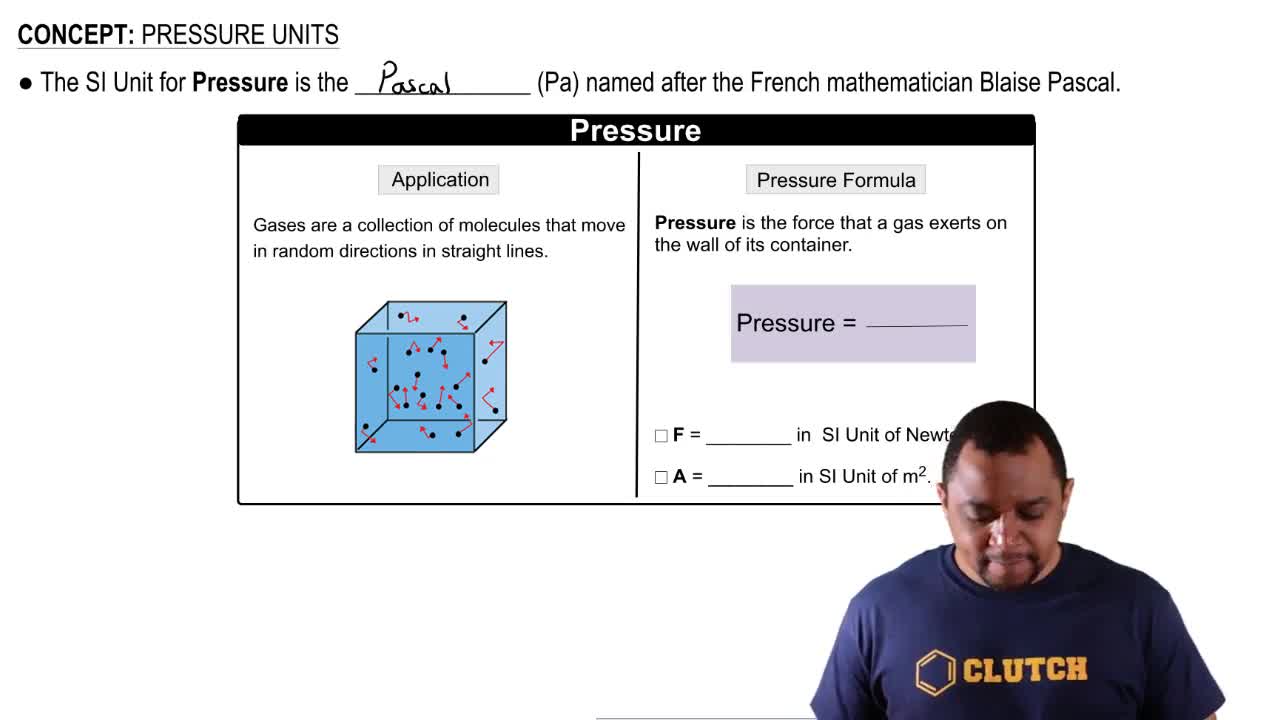
Pressure
Pressure is defined as the force exerted per unit area. In this context, atmospheric pressure is given as 14.7 psi, which means that every square inch of the surface area of the can experiences this force due to the weight of the air above it. Understanding pressure is crucial for calculating the total force acting on the can's surface.
추천 영상:
가이드 코스
Pressure Units
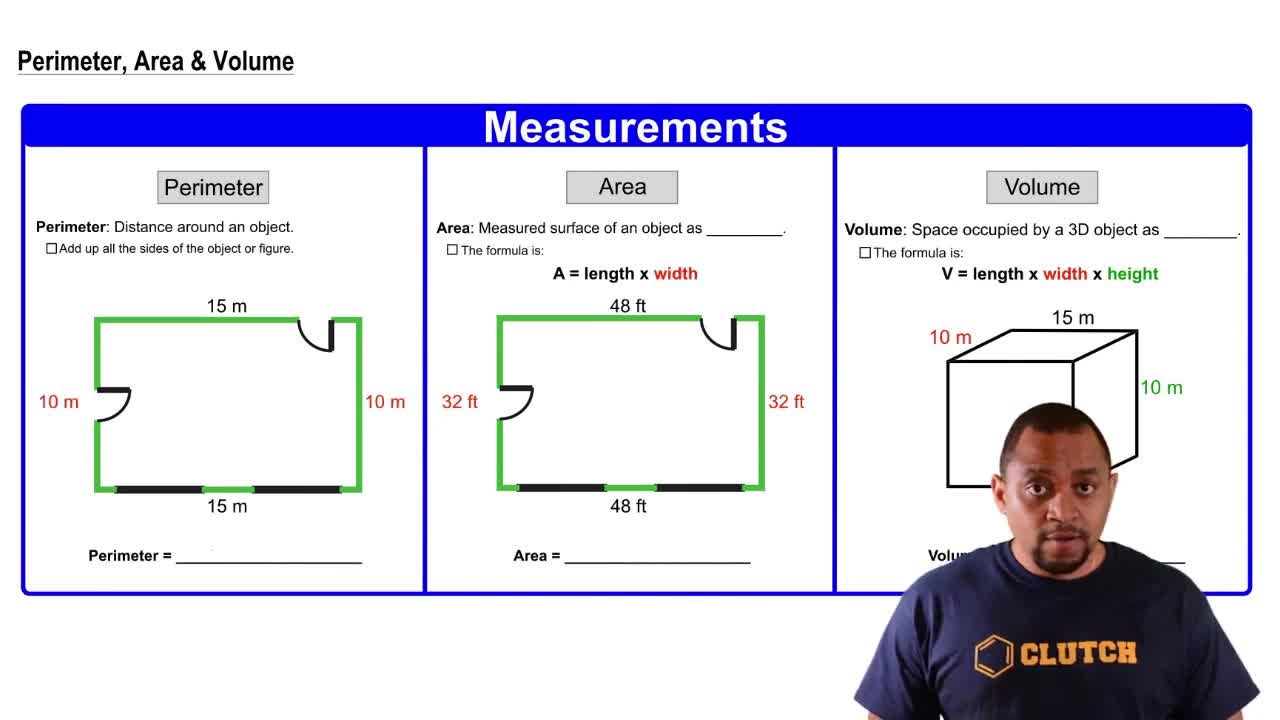
Surface Area
The surface area of an object is the total area that the surface of the object occupies. For the gasoline can, the dimensions provided (30.0 cm by 20.0 cm by 15.0 cm) can be used to calculate the total surface area. This area is essential for determining how much force is applied by the atmospheric pressure on the can.
추천 영상:
가이드 코스
Perimeter, Area, Volume
Force Calculation
Force can be calculated using the formula F = P × A, where F is the force, P is the pressure, and A is the area. In this scenario, once the surface area of the can is determined, multiplying it by the atmospheric pressure will yield the total force acting on the can. This calculation is vital to assess whether the can can withstand the resulting force.
추천 영상:
가이드 코스
Types of Intermolecular Forces
관련 실천
교과서 질문
336
views
교과서 질문
Olympic cyclists fill their tires with helium to make them lighter. Calculate the mass of air in an air-filled tire and the mass of helium in a helium-filled tire. Assume that the volume of the tire is 855 mL, that it is filled to a total pressure of 125 psi, and that the temperature is 25 °C. Also, assume an average molar mass for air of 28.8 g/mol. Calculate the mass of helium in a helium-filled tire.
1872
views
교과서 질문
An 11.5-mL sample of liquid butane (density = 0.573 g/mL) is evaporated in an otherwise empty container at a temperature of 28.5 °C. The pressure in the container following evaporation is 892 torr. What is the volume of the container?
3353
views
3
rank
