
Ch.5 - Gases
Tro - Chemistry: A Molecular Approach 4th Edition
Tro4th EditionChemistry: A Molecular ApproachISBN: 9780134112831당신이 사용하는 게 아니라요?교과서 변경
5장, 문제 114

An 11.5-mL sample of liquid butane (density = 0.573 g/mL) is evaporated in an otherwise empty container at a temperature of 28.5 °C. The pressure in the container following evaporation is 892 torr. What is the volume of the container?

검증된 단계별 안내
1
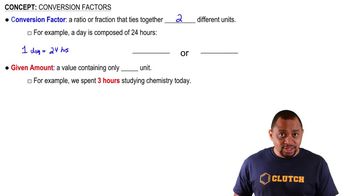
Convert the pressure from torr to atm using the conversion factor: 1 atm = 760 torr.
Calculate the mass of butane using the formula: mass = volume \(\times\) density.
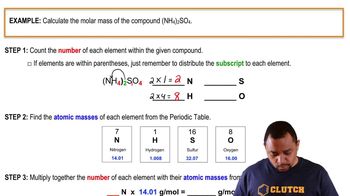
Convert the mass of butane to moles using the molar mass of butane (C_4H_{10}).
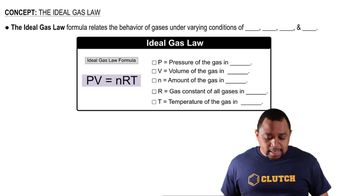
Use the ideal gas law equation, PV = nRT, to solve for the volume of the container (V).
Ensure that the temperature is converted to Kelvin by adding 273.15 to the Celsius temperature before using it in the ideal gas law equation.

비슷한 문제에 대한 검증된 영상 답변:

이 영상 해법은 위 문제에 도움이 된다고 튜터들이 추천한 것입니다.

주요 개념

질문에 올바르게 답하기 위해 반드시 이해해야 하는 핵심 개념들은 다음과 같습니다.

Density and Mass Calculation

Density is defined as mass per unit volume, typically expressed in grams per milliliter (g/mL). To find the mass of the liquid butane, you can use the formula: mass = density × volume. In this case, with a density of 0.573 g/mL and a volume of 11.5 mL, the mass can be calculated, which is essential for further calculations involving the gas phase.
추천 영상:
가이드 코스
03:12
Molar Mass Calculation Example

Ideal Gas Law

The Ideal Gas Law relates the pressure, volume, temperature, and number of moles of a gas through the equation PV = nRT. Here, P is pressure in atmospheres, V is volume in liters, n is the number of moles, R is the ideal gas constant, and T is temperature in Kelvin. This law is crucial for determining the volume of the container after the butane has evaporated.
추천 영상:
가이드 코스
01:15
Ideal Gas Law Formula

Conversion of Units

In chemistry, it is often necessary to convert units to ensure consistency in calculations. For example, pressure may need to be converted from torr to atmospheres, and volume from milliliters to liters. Understanding how to perform these conversions is vital for accurately applying the Ideal Gas Law and obtaining the correct volume of the container.
추천 영상:
가이드 코스
01:56
Conversion Factors