Ch.5 - Gases
Tro - Chemistry: A Molecular Approach 4th Edition
Tro4th EditionChemistry: A Molecular ApproachISBN: 9780134112831당신이 사용하는 게 아니라요?교과서 변경
5장, 문제 81

Consider a 1.0-L sample of helium gas and a 1.0-L sample of argon gas, both at room temperature and atmospheric pressure. a. Do the atoms in the helium sample have the same average kinetic energy as the atoms in the argon sample?

검증된 단계별 안내
1
Understand that the average kinetic energy of gas particles is related to temperature, not the type of gas.
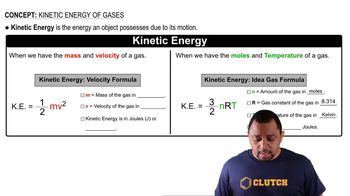
Recall that according to the kinetic molecular theory, the average kinetic energy of gas particles is given by the equation: \( KE_{avg} = \frac{3}{2}kT \), where \( k \) is the Boltzmann constant and \( T \) is the temperature in Kelvin.
Since both helium and argon gases are at the same room temperature, their average kinetic energies are the same.
Note that while the average kinetic energy is the same, the individual speeds of helium and argon atoms differ due to their different masses.
Conclude that the average kinetic energy of the atoms in the helium sample is the same as that of the atoms in the argon sample because they are at the same temperature.

비슷한 문제에 대한 검증된 영상 답변:

이 영상 해법은 위 문제에 도움이 된다고 튜터들이 추천한 것입니다.
영상 길이:
1m

주요 개념

질문에 올바르게 답하기 위해 반드시 이해해야 하는 핵심 개념들은 다음과 같습니다.

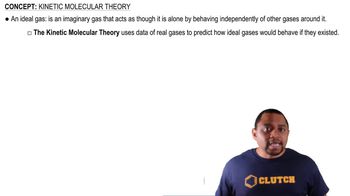
Kinetic Molecular Theory

The Kinetic Molecular Theory explains the behavior of gases in terms of particles in constant motion. It states that the average kinetic energy of gas particles is directly proportional to the temperature of the gas in Kelvin. Therefore, at the same temperature, different gases will have the same average kinetic energy, regardless of their molecular weight.
추천 영상:
가이드 코스
01:19
Kinetic Molecular Theory

Temperature and Kinetic Energy

Temperature is a measure of the average kinetic energy of the particles in a substance. For gases, this means that if two samples are at the same temperature, their particles will have the same average kinetic energy. This principle is crucial for comparing different gases, such as helium and argon, under identical conditions.
추천 영상:
가이드 코스
02:27
Kinetic Energy Formulas

Gas Properties and Behavior

Gases exhibit unique properties, including low density and high compressibility, due to the large distances between particles. The behavior of gases can be described by various gas laws, which relate pressure, volume, and temperature. Understanding these properties helps in analyzing how different gases, like helium and argon, behave under the same conditions.
추천 영상:
가이드 코스
02:49
Colligative Properties
관련 실천
교과서 질문

A flask at room temperature contains exactly equal amounts (in moles) of nitrogen and xenon. a. Which of the two gases exerts the greater partial pressure?

1666
views

교과서 질문

A flask at room temperature contains exactly equal amounts (in moles) of nitrogen and xenon. b. The molecules or atoms of which gas have the greater average velocity? d. If a small hole were opened in the flask, which gas effuses more quickly?

교과서 질문

Carbon monoxide gas reacts with hydrogen gas to form methanol. CO(g) + 2 H2(g) → CH3OH(g) A 1.50-L reaction vessel, initially at 305 K, contains carbon monoxide gas at a partial pressure of 232 mmHg and hydrogen gas at a partial pressure of 397 mmHg. Identify the limiting reactant. Determine the theoretical yield of methanol in grams.

11932
views
교과서 질문

Ozone is depleted in the stratosphere by chlorine from CF3Cl according to this set of equations:

CF3Cl + UV light → CF3 + Cl

Cl + O3 → ClO + O2

O3 + UV light → O2 + O

ClO + O → Cl + O2

What total volume of ozone at a pressure of 25.0 mmHg and a temperature of 225 K is destroyed when all of the chlorine from 15.0 g of CF3Cl goes through 10 cycles of the given reactions?

1494
views
교과서 질문

Chlorine gas reacts with fluorine gas to form chlorine trifluoride. Cl2(g) + 3 F2(g) → 2 ClF3(g) A 2.00-L reaction vessel, initially at 298 K, contains chlorine gas at a partial pressure of 337 mmHg and fluorine gas at a partial pressure of 729 mmHg. Identify the limiting reactant. Determine the theoretical yield of ClF3 in grams.

5162
views
1
rank
교과서 질문

A flask at room temperature contains exactly equal amounts (in moles) of nitrogen and xenon. c. The molecules of which gas have the greater average kinetic energy?

615
views