
Ch.6 - Thermochemistry
Tro - Chemistry: A Molecular Approach 4th Edition
Tro4th EditionChemistry: A Molecular ApproachISBN: 9780134112831당신이 사용하는 게 아니라요?교과서 변경
6장, 문제 48

How much heat is required to warm 1.50 kg of sand from 25.0 °C to 100.0 °C?

검증된 단계별 안내
1
Identify the specific heat capacity of sand, which is typically around 0.290 J/g°C.
Convert the mass of sand from kilograms to grams. Since 1 kg equals 1000 grams, multiply the mass of the sand by 1000.
Calculate the temperature change (ΔT) by subtracting the initial temperature from the final temperature.
Use the formula for heat (q) required: q = m * c * ΔT, where m is the mass in grams, c is the specific heat capacity, and ΔT is the temperature change.
Substitute the values into the formula to find the amount of heat required.

비슷한 문제에 대한 검증된 영상 답변:

이 영상 해법은 위 문제에 도움이 된다고 튜터들이 추천한 것입니다.
영상 길이:
1m

주요 개념

질문에 올바르게 답하기 위해 반드시 이해해야 하는 핵심 개념들은 다음과 같습니다.

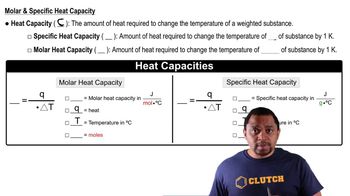
Specific Heat Capacity

Specific heat capacity is the amount of heat required to raise the temperature of one kilogram of a substance by one degree Celsius. It is a material-specific property that varies between different substances. For sand, the specific heat capacity is approximately 0.84 J/g°C, which means it requires this amount of energy to increase its temperature.
추천 영상:

Heat Transfer Equation

The heat transfer equation, often expressed as Q = mcΔT, relates the heat energy (Q) absorbed or released by a substance to its mass (m), specific heat capacity (c), and the change in temperature (ΔT). This equation is fundamental in calculating the heat required for temperature changes in various materials, allowing for precise energy calculations in thermal processes.
추천 영상:

Temperature Change

Temperature change (ΔT) is the difference between the final and initial temperatures of a substance. In this case, it is calculated as 100.0 °C - 25.0 °C, resulting in a ΔT of 75.0 °C. Understanding temperature change is crucial for determining how much heat energy is needed to achieve the desired temperature increase in a material.
추천 영상:
가이드 코스
02:03
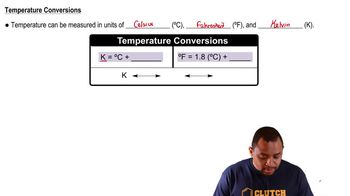
Temperature Conversion Formulas
관련 실천
교과서 질문

A kilogram of aluminum metal and a kilogram of water are each warmed to 75 °C and placed in two identical insulated containers. One hour later, the two containers are opened and the temperature of each substance is measured. The aluminum has cooled to 35 °C, while the water has cooled only to 66 °C. Explain this difference.

1214
views
교과서 질문

How much heat is required to warm 1.50 L of water from 25.0 °C to 100.0 °C? (Assume a density of 1.0 g/mL for the water.)

2156
views
교과서 질문

An unknown mass of each substance, initially at 23.0 °C, absorbs 1.95 × 10³ J of heat. The final temperature is recorded. Find the mass of each substance.

a. Pyrex glass (Tf = 55.4°C)

b. sand (Tf = 62.1°C)

c. ethanol (Tf = 44.2°C)

d. water (Tf = 32.4°C)

1478
views
교과서 질문

We pack two identical coolers for a picnic, placing 24 12-ounce soft drinks and five pounds of ice in each. However, the drinks that we put into cooler A were refrigerated for several hours before they were packed in the cooler, while the drinks that we put into cooler B were at room temperature. When we open the two coolers three hours later, most of the ice in cooler A is still present, while nearly all of the ice in cooler B has melted. Explain this difference.

1120
views
교과서 질문

How much work (in J) is required to expand the volume of a pump from 0.0 L to 2.5 L against an external pressure of 1.1 atm?

1630
views
교과서 질문

Suppose that 25 g of each substance is initially at 27.0 °C. What is the final temperature of each substance upon absorbing 2.35 kJ of heat? c. aluminum

2959
views