Use standard enthalpies of formation to calculate ΔH°rxn for each reaction. a. C2H4(g) + H2(g) → C2H6(g)
Ch.6 - Thermochemistry
6장, 문제 85
Hydrazine (N2H4) is a fuel used by some spacecraft. It is normally oxidized by N2O4 according to the equation: N2H4 (l) + N2O4 (g) → 2 N2O (g) + 2 H2O (g) Calculate ΔH°rxn for this reaction using standard enthalpies of formation.
검증된 단계별 안내1
Identify the standard enthalpies of formation (ΔH°f) for each of the reactants and products involved in the reaction. These values are typically found in a chemistry reference or textbook. For this reaction, you need the ΔH°f for N2H4 (l), N2O4 (g), N2O (g), and H2O (g).
Write down the balanced chemical equation: N2H4 (l) + N2O4 (g) → 2 N2O (g) + 2 H2O (g).
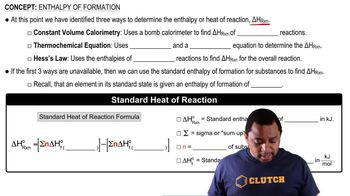
Apply the formula for calculating the standard enthalpy change of the reaction (ΔH°rxn): ΔH°rxn = ΣΔH°f(products) - ΣΔH°f(reactants). Remember to multiply the ΔH°f of each substance by its stoichiometric coefficient in the balanced equation.
Substitute the standard enthalpies of formation into the equation. Make sure to use the correct signs (positive or negative) as provided by the standard enthalpies of formation values.
Calculate the sum of the standard enthalpies of formation for the products and reactants separately, then find the difference between these sums to determine ΔH°rxn.

비슷한 문제에 대한 검증된 영상 답변:
이 영상 해법은 위 문제에 도움이 된다고 튜터들이 추천한 것입니다.
영상 길이:
5m도움이 되었나요?
주요 개념
질문에 올바르게 답하기 위해 반드시 이해해야 하는 핵심 개념들은 다음과 같습니다.
Standard Enthalpy of Formation
The standard enthalpy of formation (ΔH°f) is the change in enthalpy when one mole of a compound is formed from its elements in their standard states. It is a crucial value used in thermodynamics to calculate the overall energy change in chemical reactions. Each substance has a specific ΔH°f value, which can be found in tables, and is essential for determining the enthalpy change of a reaction.
추천 영상:
가이드 코스
Enthalpy of Formation
Hess's Law
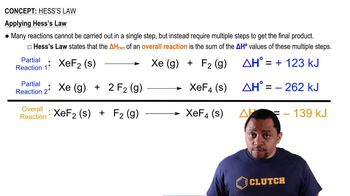
Hess's Law states that the total enthalpy change for a reaction is the same, regardless of the number of steps taken to achieve the reaction. This principle allows for the calculation of the enthalpy change of a reaction by summing the enthalpy changes of individual steps, making it possible to use standard enthalpies of formation to find ΔH°rxn for complex reactions.
추천 영상:
가이드 코스
Hess's Law
Enthalpy Change of a Reaction (ΔH°rxn)
The enthalpy change of a reaction (ΔH°rxn) is the difference between the total enthalpy of the products and the total enthalpy of the reactants under standard conditions. It indicates whether a reaction is exothermic (releases heat, ΔH°rxn < 0) or endothermic (absorbs heat, ΔH°rxn > 0). Calculating ΔH°rxn using standard enthalpies of formation involves subtracting the sum of the ΔH°f values of the reactants from that of the products.
추천 영상:
가이드 코스
Enthalpy of Formation
관련 실천
교과서 질문
1003
views
교과서 질문
Write an equation for the formation of each compound from its elements in their standard states, and find ΔH°rxn for each in Appendix IIB. d. CH3OH(l)
435
views
교과서 질문
Write an equation for the formation of each compound from its elements in their standard states, and find ΔH°rxn for each in Appendix IIB. b. MgCO3(s)
1906
views
교과서 질문
Pentane (C5H12) is a component of gasoline that burns according to the following balanced equation: C5H12(l) + 8 O2(g) → 5 CO2(g) + 6 H2O(g) Calculate ΔH°rxn for this reaction using standard enthalpies of formation. (The standard enthalpy of formation of liquid pentane is –146.8 kJ/mol.)
8543
views
3
rank
교과서 질문
Write an equation for the formation of each compound from its elements in their standard states, and find ΔH°rxn for each in Appendix IIB. a. NO2(g)