
Ch.6 - Thermochemistry
Tro - Chemistry: A Molecular Approach 4th Edition
Tro4th EditionChemistry: A Molecular ApproachISBN: 9780134112831당신이 사용하는 게 아니라요?교과서 변경
6장, 문제 86

Pentane (C5H12) is a component of gasoline that burns according to the following balanced equation: C5H12(l) + 8 O2(g) → 5 CO2(g) + 6 H2O(g) Calculate ΔH°rxn for this reaction using standard enthalpies of formation. (The standard enthalpy of formation of liquid pentane is –146.8 kJ/mol.)

검증된 단계별 안내
1
Identify the balanced chemical equation for the combustion of pentane: \( \text{C}_5\text{H}_{12}(l) + 8 \text{O}_2(g) \rightarrow 5 \text{CO}_2(g) + 6 \text{H}_2\text{O}(g) \).
Recall that the standard enthalpy change of reaction (\( \Delta H^\circ_{\text{rxn}} \)) can be calculated using the formula: \( \Delta H^\circ_{\text{rxn}} = \sum \Delta H^\circ_f(\text{products}) - \sum \Delta H^\circ_f(\text{reactants}) \).
Look up the standard enthalpies of formation (\( \Delta H^\circ_f \)) for each substance involved in the reaction: \( \text{CO}_2(g) \), \( \text{H}_2\text{O}(g) \), and \( \text{O}_2(g) \). Note that the \( \Delta H^\circ_f \) for \( \text{O}_2(g) \) is zero because it is in its standard state.
Calculate the total \( \Delta H^\circ_f \) for the products: \( 5 \times \Delta H^\circ_f(\text{CO}_2(g)) + 6 \times \Delta H^\circ_f(\text{H}_2\text{O}(g)) \).
Calculate \( \Delta H^\circ_{\text{rxn}} \) by substituting the values into the formula: \( \Delta H^\circ_{\text{rxn}} = [5 \times \Delta H^\circ_f(\text{CO}_2(g)) + 6 \times \Delta H^\circ_f(\text{H}_2\text{O}(g))] - [\Delta H^\circ_f(\text{C}_5\text{H}_{12}(l)) + 8 \times \Delta H^\circ_f(\text{O}_2(g))] \).

비슷한 문제에 대한 검증된 영상 답변:

이 영상 해법은 위 문제에 도움이 된다고 튜터들이 추천한 것입니다.
도움이 되었나요?

주요 개념

질문에 올바르게 답하기 위해 반드시 이해해야 하는 핵심 개념들은 다음과 같습니다.

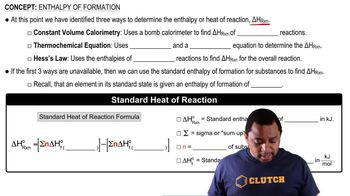
Standard Enthalpy of Formation

The standard enthalpy of formation (ΔH°f) is the change in enthalpy when one mole of a compound is formed from its elements in their standard states. It is a crucial value used in thermodynamics to calculate the overall enthalpy change of a reaction. For example, the ΔH°f of liquid pentane is given as -146.8 kJ/mol, indicating that energy is released when pentane is formed from its elemental components.
추천 영상:
가이드 코스
02:34
Enthalpy of Formation

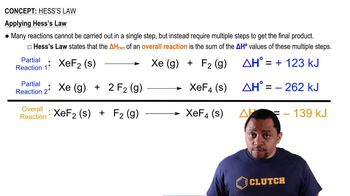
Hess's Law

Hess's Law states that the total enthalpy change for a reaction is the sum of the enthalpy changes for the individual steps of the reaction, regardless of the pathway taken. This principle allows us to calculate the enthalpy change of a reaction by using the standard enthalpies of formation of the reactants and products. It is particularly useful when direct measurement of ΔH°rxn is difficult.
추천 영상:

Enthalpy Change of a Reaction (ΔH°rxn)

The enthalpy change of a reaction (ΔH°rxn) is the difference between the total enthalpy of the products and the total enthalpy of the reactants, calculated under standard conditions. It indicates whether a reaction is exothermic (releases heat, ΔH°rxn < 0) or endothermic (absorbs heat, ΔH°rxn > 0). In the combustion of pentane, this value can be determined using the standard enthalpies of formation of the products and reactants.
추천 영상:
가이드 코스
02:34
Enthalpy of Formation