
Ch.6 - Thermochemistry
Tro - Chemistry: A Molecular Approach 4th Edition
Tro4th EditionChemistry: A Molecular ApproachISBN: 9780134112831당신이 사용하는 게 아니라요?교과서 변경
6장, 문제 94

Methanol (CH3OH) has been suggested as a fuel to replace gasoline. Find ΔH°rxn, and determine the mass of carbon dioxide emitted per kJ of heat produced. Use the information from the previous exercise to calculate the same quantity for octane, C8H18. How does methanol compare to octane with respect to global warming?

검증된 단계별 안내
1
insert step 1> Identify the balanced chemical equations for the combustion of methanol (CH3OH) and octane (C8H18).
insert step 2> Use standard enthalpies of formation (ΔH °f) to calculate the standard enthalpy change of reaction (ΔH °rxn) for each combustion reaction.
insert step 3> Calculate the amount of CO2 produced per mole of fuel combusted for both methanol and octane.
insert step 4> Determine the mass of CO2 emitted per kJ of heat produced by dividing the mass of CO2 by the ΔH °rxn for each fuel.
insert step 5> Compare the mass of CO2 emitted per kJ of heat for methanol and octane to assess their impact on global warming.

비슷한 문제에 대한 검증된 영상 답변:

이 영상 해법은 위 문제에 도움이 된다고 튜터들이 추천한 것입니다.
영상 길이:
14m
도움이 되었나요?

주요 개념

질문에 올바르게 답하기 위해 반드시 이해해야 하는 핵심 개념들은 다음과 같습니다.

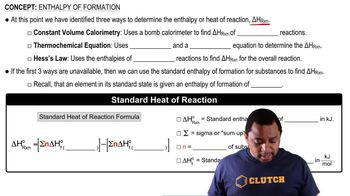
Enthalpy of Reaction (ΔH°rxn)

Enthalpy of reaction, denoted as ΔH°rxn, is the heat change that occurs during a chemical reaction at constant pressure. It indicates whether a reaction is exothermic (releases heat, ΔH°rxn < 0) or endothermic (absorbs heat, ΔH°rxn > 0). Understanding ΔH°rxn is crucial for evaluating the energy efficiency of fuels like methanol and octane, as it helps determine how much energy is released when these substances combust.
추천 영상:
가이드 코스
02:34
Enthalpy of Formation

Combustion and Carbon Dioxide Emission

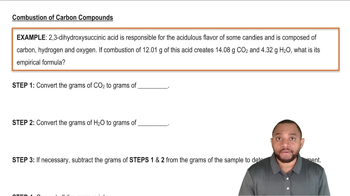
Combustion is a chemical reaction that typically involves a fuel reacting with oxygen to produce heat, carbon dioxide, and water. The amount of carbon dioxide emitted per kJ of heat produced is a critical measure of a fuel's environmental impact, particularly concerning global warming. By comparing the CO2 emissions from methanol and octane, we can assess their relative contributions to greenhouse gas emissions.
추천 영상:
가이드 코스
5:59
Combustion of Carbon Compounds Example

Global Warming Potential (GWP)

Global warming potential (GWP) is a measure of how much heat a greenhouse gas traps in the atmosphere over a specific time period, relative to carbon dioxide. It is essential for evaluating the environmental impact of different fuels. Methanol and octane have different GWP values due to their combustion products and efficiencies, influencing their suitability as sustainable energy sources in the context of climate change.
추천 영상:
가이드 코스
00:34
Kinetic & Potential Energy
관련 실천
교과서 질문

Top fuel dragsters and funny cars burn nitromethane as fuel according to the balanced combustion equation: 2 CH3NO2(l) + 3/2O2(g) → 2 CO2(g) + 3 H2O(l) + N2(g) ΔH°rxn = –1418 kJ The enthalpy of combustion for nitromethane is –709.2 kJ/mol. Calculate the standard enthalpy of formation (ΔH°f ) for nitromethane.

3123
views
3
comments
교과서 질문

Determine the mass of CO2 produced by burning enough of each fuel to produce 1.00×10² kJ of heat. a. CH4(g) + 2 O2(g) → CO2(g) + 2 H2O(g) ΔH°rxn = –802.3 kJ

3776
views
1
rank
교과서 질문

The explosive nitroglycerin (C3H5N3O9) decomposes rapidly upon ignition or sudden impact according to the balanced equation: 4 C3H5N3O9(l) → 12 CO2(g) + 10 H2O(g) + 6 N2(g) + O2(g) ΔH°rxn = –5678 kJ Calculate the standard enthalpy of formation (ΔH°f ) for nitroglycerin.

7072
views
교과서 질문

In a sunny location, sunlight has a power density of about 1 kW/m2. Photovoltaic solar cells can convert this power into electricity with 15% efficiency. If a typical home uses 385 kWh of electricity per month, how many square meters of solar cells are required to meet its energy requirements? Assume that electricity can be generated from the sunlight for 8 hours per day.

685
views
교과서 질문

The kinetic energy of a rolling billiard ball is given by KE = 1/2 mv2. Suppose a 0.17-kg billiard ball is rolling down a pool table with an initial speed of 4.5 m/s. As it travels, it loses some of its energy as heat. The ball slows down to 3.8 m/s and then collides head-on with a second billiard ball of equal mass. The first billiard ball completely stops and the second one rolls away with a velocity of 3.8 m/s. Assume the first billiard ball is the system. Calculate q.

1553
views