
In a sunny location, sunlight has a power density of about 1 kW/m2. Photovoltaic solar cells can convert this power into electricity with 15% efficiency. If a typical home uses 385 kWh of electricity per month, how many square meters of solar cells are required to meet its energy requirements? Assume that electricity can be generated from the sunlight for 8 hours per day.
Ch.6 - Thermochemistry
6장, 문제 97b
The kinetic energy of a rolling billiard ball is given by KE = 1/2 mv2. Suppose a 0.17-kg billiard ball is rolling down a pool table with an initial speed of 4.5 m/s. As it travels, it loses some of its energy as heat. The ball slows down to 3.8 m/s and then collides head-on with a second billiard ball of equal mass. The first billiard ball completely stops and the second one rolls away with a velocity of 3.8 m/s. Assume the first billiard ball is the system. Calculate q.
검증된 단계별 안내1
Identify the initial kinetic energy (KE_initial) of the first billiard ball using the formula KE = \(\frac{1}{2}\)mv^2, where m is the mass and v is the initial velocity.
Calculate the initial kinetic energy: KE_initial = \(\frac{1}{2}\) \(\times\) 0.17 \(\text{ kg}\) \(\times\) (4.5 \(\text{ m/s}\))^2.
Identify the final kinetic energy (KE_final) of the first billiard ball just before the collision using the same formula with the final velocity.
Calculate the final kinetic energy: KE_final = \(\frac{1}{2}\) \(\times\) 0.17 \(\text{ kg}\) \(\times\) (3.8 \(\text{ m/s}\))^2.
Determine the heat lost (q) by the system, which is the difference between the initial and final kinetic energies: q = KE_initial - KE_final.

비슷한 문제에 대한 검증된 영상 답변:
이 영상 해법은 위 문제에 도움이 된다고 튜터들이 추천한 것입니다.
영상 길이:
4m주요 개념
질문에 올바르게 답하기 위해 반드시 이해해야 하는 핵심 개념들은 다음과 같습니다.
Kinetic Energy
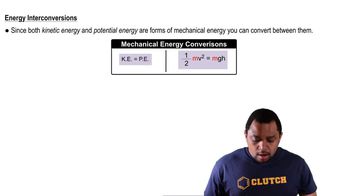
Kinetic energy (KE) is the energy an object possesses due to its motion, calculated using the formula KE = 1/2 mv², where m is the mass and v is the velocity of the object. In this scenario, the billiard ball's kinetic energy changes as it slows down and eventually transfers its energy during a collision.
추천 영상:
가이드 코스
Kinetic & Potential Energy
Conservation of Momentum
The principle of conservation of momentum states that in a closed system, the total momentum before an event must equal the total momentum after the event. In this case, the momentum of the first billiard ball is transferred to the second ball during the collision, allowing us to analyze the system's behavior before and after the impact.
추천 영상:
가이드 코스
Law of Conservation of Mass
Heat Transfer (q)
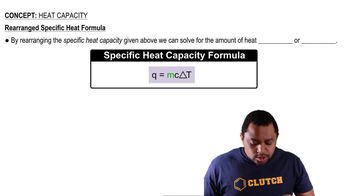
Heat transfer, denoted as q, refers to the energy that is transferred from one system to another due to a temperature difference. In this problem, as the first billiard ball slows down, some of its kinetic energy is converted into heat, which can be quantified to understand the energy lost during its motion.
추천 영상:
가이드 코스
Heat Capacity
관련 실천
교과서 질문
685
views
교과서 질문
LP gas burns according to the exothermic reaction: C3H8(g) + 5 O2(g) → 3 CO2(g) + 4 H2O(g) ΔH°rxn = –2044 kJ What mass of LP gas is necessary to heat 1.5 L of water from room temperature (25.0 °C) to boiling (100.0 °C)? Assume that during heating, 15% of the heat emitted by the LP gas combustion goes to heat the water. The rest is lost as heat to the surroundings.
2175
views
1
rank
교과서 질문
Methanol (CH3OH) has been suggested as a fuel to replace gasoline. Find ΔH°rxn, and determine the mass of carbon dioxide emitted per kJ of heat produced. Use the information from the previous exercise to calculate the same quantity for octane, C8H18. How does methanol compare to octane with respect to global warming?
1193
views
