Ch.8 - Periodic Properties of the Elements
Tro - Chemistry: A Molecular Approach 4th Edition
Tro4th EditionChemistry: A Molecular ApproachISBN: 9780134112831당신이 사용하는 게 아니라요?교과서 변경
8장, 문제 58

Arrange the atoms according to decreasing effective nuclear charge experienced by their valence electrons: S, Mg, Al, Si.

검증된 단계별 안내
1
Understand that effective nuclear charge \( (Z_{eff}) \) is the net positive charge experienced by valence electrons. It is calculated as \( Z_{eff} = Z - S \), where \( Z \) is the atomic number and \( S \) is the shielding constant.
Identify the atomic numbers: Sulfur (S) is 16, Magnesium (Mg) is 12, Aluminum (Al) is 13, and Silicon (Si) is 14.
Consider the electron configuration for each element to determine the shielding effect. The more inner electrons, the greater the shielding.
Recognize that elements in the same period have increasing \( Z_{eff} \) from left to right due to increasing atomic number and similar shielding.
Arrange the elements in order of decreasing \( Z_{eff} \): Sulfur (S), Silicon (Si), Aluminum (Al), Magnesium (Mg).

비슷한 문제에 대한 검증된 영상 답변:

이 영상 해법은 위 문제에 도움이 된다고 튜터들이 추천한 것입니다.
영상 길이:
3m
도움이 되었나요?

주요 개념

질문에 올바르게 답하기 위해 반드시 이해해야 하는 핵심 개념들은 다음과 같습니다.

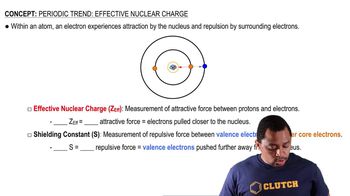
Effective Nuclear Charge (Z_eff)

Effective nuclear charge is the net positive charge experienced by an electron in a multi-electron atom. It accounts for the actual nuclear charge (number of protons) minus the shielding effect of inner-shell electrons. This concept is crucial for understanding how strongly valence electrons are attracted to the nucleus, influencing atomic size and reactivity.
추천 영상:
가이드 코스
01:51
Effective Nuclear Charge

Shielding Effect

The shielding effect refers to the phenomenon where inner-shell electrons partially block the attraction between the nucleus and the valence electrons. This results in a lower effective nuclear charge felt by the outermost electrons. Understanding this effect is essential for predicting trends in atomic properties across the periodic table.
추천 영상:
가이드 코스
02:31
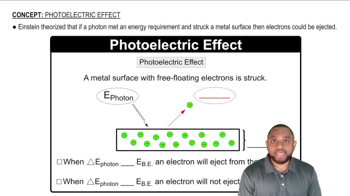
Photoelectric Effect

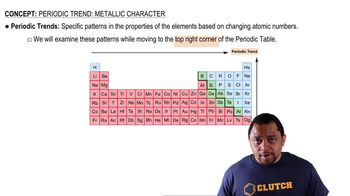
Periodic Trends

Periodic trends are patterns observed in the properties of elements as you move across or down the periodic table. Key trends include atomic radius, ionization energy, and electronegativity, which are influenced by effective nuclear charge and shielding. Recognizing these trends helps in arranging elements based on their atomic characteristics, such as effective nuclear charge.
추천 영상:
가이드 코스
00:38
Periodic Trends
관련 실천
교과서 질문

Which experience a greater effective nuclear charge: the valence electrons in beryllium or the valence electrons in nitrogen? Why?

2134
views

교과서 질문

If core electrons completely shielded valence electrons from nuclear charge (i.e., if each core electron reduced nuclear charge by 1 unit) and if valence electrons did not shield one another from nuclear charge at all, what would be the effective nuclear charge experienced by the valence electrons of each atom? a. K

629
views
교과서 질문

According to Coulomb's law, rank the interactions between charged particles from lowest potential energy to highest potential energy. a. a 1+ charge and a 1- charge separated by 100 pm b. a 2+ charge and a 1- charge separated by 100 pm c. a 1+ charge and a 1+ charge separated by 100 pm d. a 1+ charge and a 1- charge separated by 200 pm

676
views
교과서 질문

According to Coulomb's law, which pair of charged particles has the lowest potential energy? a. a particle with a 1- charge separated by 150 pm from a particle with a 2+ charge b. a particle with a 1- charge separated by 150 pm from a particle with a 1+ charge c. a particle with a 1- charge separated by 100 pm from a particle with a 3+ charge

3405
views
교과서 질문

If core electrons completely shielded valence electrons from nuclear charge (i.e., if each core electron reduced nuclear charge by 1 unit) and if valence electrons did not shield one another from nuclear charge at all, what would be the effective nuclear charge experienced by the valence electrons of each atom? b. Ca

528
views
교과서 질문

If core electrons completely shielded valence electrons from nuclear charge (i.e., if each core electron reduced nuclear charge by 1 unit) and if valence electrons did not shield one another from nuclear charge at all, what would be the effective nuclear charge experienced by the valence electrons of each atom? c. O d. C

2895
views
1
rank