Ch.8 - Periodic Properties of the Elements
Tro - Chemistry: A Molecular Approach 4th Edition
Tro4th EditionChemistry: A Molecular ApproachISBN: 9780134112831당신이 사용하는 게 아니라요?교과서 변경
8장, 문제 72

Arrange this isoelectronic series in order of increasing atomic radius: Se2- , Sr2+ , Rb+ , Br- .

검증된 단계별 안내
1
Identify the number of electrons in each ion. Since the series is isoelectronic, all ions have the same number of electrons.
Determine the number of protons in each ion: Se has 34 protons, Sr has 38 protons, Rb has 37 protons, and Br has 35 protons.
Recall that in an isoelectronic series, the ion with the fewest protons will have the largest atomic radius because the effective nuclear charge is lower, resulting in less attraction between the nucleus and the electrons.
Arrange the ions in order of increasing number of protons: Se^{2-} (34 protons), Br^{-} (35 protons), Rb^{+} (37 protons), Sr^{2+} (38 protons).
Based on the number of protons, arrange the ions in order of increasing atomic radius: Sr^{2+}, Rb^{+}, Br^{-}, Se^{2-}.

비슷한 문제에 대한 검증된 영상 답변:

이 영상 해법은 위 문제에 도움이 된다고 튜터들이 추천한 것입니다.

주요 개념

질문에 올바르게 답하기 위해 반드시 이해해야 하는 핵심 개념들은 다음과 같습니다.

Isoelectronic Species

Isoelectronic species are atoms or ions that have the same number of electrons and, therefore, the same electronic configuration. In this question, Se<sup>2-</sup>, Sr<sup>2+</sup>, Rb<sup>+</sup>, and Br<sup>-</sup> all have 36 electrons, making them isoelectronic. Understanding this concept is crucial for comparing their atomic radii, as they share similar electron arrangements.
추천 영상:
가이드 코스
03:03
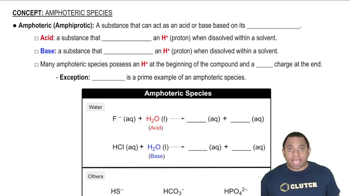
Amphoteric Species

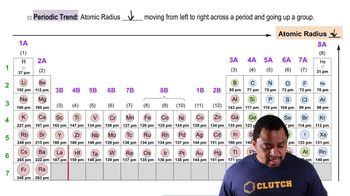
Atomic Radius Trends

Atomic radius refers to the size of an atom, typically measured from the nucleus to the outermost electron shell. In general, atomic radius increases down a group in the periodic table due to the addition of electron shells, while it decreases across a period due to increased nuclear charge. For isoelectronic species, the effective nuclear charge experienced by the electrons influences their size, with more protons pulling electrons closer and resulting in a smaller radius.
추천 영상:
가이드 코스
01:42
Atomic Radius Trends

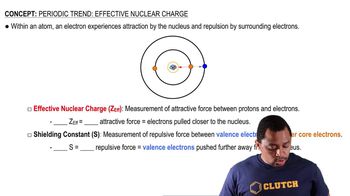
Effective Nuclear Charge (Z_eff)

Effective nuclear charge (Z_eff) is the net positive charge experienced by an electron in a multi-electron atom, accounting for both the total nuclear charge and the shielding effect of inner electrons. In the context of isoelectronic species, the greater the number of protons in the nucleus, the higher the Z_eff, leading to a smaller atomic radius. Thus, comparing the atomic radii of the given ions involves analyzing their respective nuclear charges and how they affect the size of the electron cloud.
추천 영상:
가이드 코스
01:51
Effective Nuclear Charge