Ch.8 - Periodic Properties of the Elements
Tro - Chemistry: A Molecular Approach 4th Edition
Tro4th EditionChemistry: A Molecular ApproachISBN: 9780134112831당신이 사용하는 게 아니라요?교과서 변경
8장, 문제 69

Which is the larger species in each pair? a. Li or Li+ b. Cs- or Cs+ c. Cr- or Cr3+ d. O or O2-

검증된 단계별 안내
1
1. The size of an atom or ion is determined by the number of electron shells it has (which is determined by the number of electrons) and the effective nuclear charge (the net positive charge experienced by an electron in a multi-electron atom).
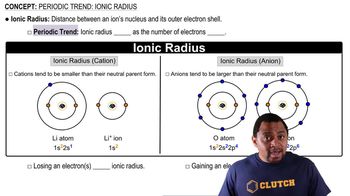
2. For a. Li or Li+: Li+ has one less electron than Li, meaning it has fewer electron shells and a greater effective nuclear charge. Therefore, Li is larger than Li+.
3. For b. Cs- or Cs+: Cs- has one more electron than Cs, meaning it has more electron shells and a smaller effective nuclear charge. Therefore, Cs- is larger than Cs+.
4. For c. Cr- or Cr3+: Cr3+ has three less electrons than Cr, meaning it has fewer electron shells and a greater effective nuclear charge. Therefore, Cr is larger than Cr3+.
5. For d. O or O2-: O2- has two more electrons than O, meaning it has more electron shells and a smaller effective nuclear charge. Therefore, O2- is larger than O.

비슷한 문제에 대한 검증된 영상 답변:

이 영상 해법은 위 문제에 도움이 된다고 튜터들이 추천한 것입니다.

주요 개념

질문에 올바르게 답하기 위해 반드시 이해해야 하는 핵심 개념들은 다음과 같습니다.

Ionic Radius

Ionic radius refers to the size of an ion in a crystal lattice. Cations, which are positively charged ions, are generally smaller than their neutral atoms due to the loss of electrons, leading to reduced electron-electron repulsion. Conversely, anions, which are negatively charged ions, are larger than their neutral atoms because the addition of electrons increases repulsion among them, resulting in a larger size.
추천 영상:

Charge and Size Relationship

The charge of an ion significantly affects its size. As the positive charge increases (e.g., from Cr to Cr³⁺), the ion becomes smaller due to the increased attraction between the nucleus and the remaining electrons. In contrast, when an atom gains electrons to form an anion, the size increases due to the added electron-electron repulsion, making the ion larger than its neutral counterpart.
추천 영상:

Comparative Analysis of Ions

When comparing ions, it is essential to consider both their charge and the number of electrons. For example, when comparing Li and Li⁺, the neutral Li atom is larger than the Li⁺ ion. Similarly, when comparing Cs⁻ and Cs⁺, the Cs⁻ ion is larger due to the additional electron. This comparative analysis helps determine which species is larger in each pair presented in the question.
추천 영상:
가이드 코스
06:11
Dimensional Analysis