Ch.8 - Periodic Properties of the Elements
Tro - Chemistry: A Molecular Approach 4th Edition
Tro4th EditionChemistry: A Molecular ApproachISBN: 9780134112831당신이 사용하는 게 아니라요?교과서 변경
8장, 문제 114

Consider the elements: Na, Mg, Al, Si, P. a. Which element has the highest second ionization energy?

검증된 단계별 안내
1
Identify the elements given: Na, Mg, Al, Si, P.
Understand that the second ionization energy is the energy required to remove the second electron after the first has already been removed.
Consider the electronic configurations of the elements after the first electron is removed: Na^+, Mg^+, Al^+, Si^+, P^+.
Recognize that the second ionization energy is highest for the element that achieves a stable electron configuration after the first ionization.
Determine which element, after losing one electron, has a stable noble gas configuration or a half-filled or fully filled subshell, making it difficult to remove the second electron.

비슷한 문제에 대한 검증된 영상 답변:

이 영상 해법은 위 문제에 도움이 된다고 튜터들이 추천한 것입니다.
영상 길이:
1m
도움이 되었나요?

주요 개념

질문에 올바르게 답하기 위해 반드시 이해해야 하는 핵심 개념들은 다음과 같습니다.

Ionization Energy

Ionization energy is the energy required to remove an electron from an atom or ion in its gaseous state. It is a key factor in determining an element's reactivity and is influenced by the atomic structure, including the number of protons and the distance of electrons from the nucleus. Generally, ionization energy increases across a period and decreases down a group in the periodic table.
추천 영상:
가이드 코스
01:19
Ionization Energy

Second Ionization Energy

The second ionization energy refers to the energy needed to remove a second electron from a singly charged cation. This value is typically higher than the first ionization energy because the remaining electrons experience a greater effective nuclear charge, making them more tightly bound to the nucleus. Understanding the trends in second ionization energy helps predict the stability of ions formed from elements.
추천 영상:
가이드 코스
01:19
Ionization Energy

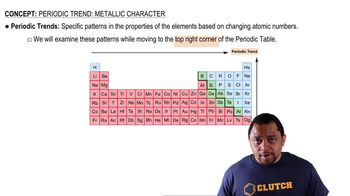
Periodic Trends

Periodic trends are patterns observed in the periodic table that describe how certain properties of elements change across periods and down groups. For ionization energy, trends show that it generally increases from left to right across a period due to increasing nuclear charge and decreases from top to bottom in a group due to increased electron shielding. Recognizing these trends is essential for predicting the behavior of elements during ionization.
추천 영상:
가이드 코스
00:38
Periodic Trends