Ch.8 - Periodic Properties of the Elements
Tro - Chemistry: A Molecular Approach 4th Edition
Tro4th EditionChemistry: A Molecular ApproachISBN: 9780134112831당신이 사용하는 게 아니라요?교과서 변경
8장, 문제 114d

Consider the elements: Na, Mg, Al, Si, P. d. Which element is diamagnetic?

검증된 단계별 안내
1
Understand the concept of diamagnetism: Diamagnetic substances are those that have all their electrons paired and do not have any unpaired electrons.
Review the electron configurations of the given elements: Na, Mg, Al, Si, and P.
Identify the electron configuration for each element: Na (1s^2 2s^2 2p^6 3s^1), Mg (1s^2 2s^2 2p^6 3s^2), Al (1s^2 2s^2 2p^6 3s^2 3p^1), Si (1s^2 2s^2 2p^6 3s^2 3p^2), P (1s^2 2s^2 2p^6 3s^2 3p^3).
Determine which element has all paired electrons in its electron configuration.
Conclude that the element with all paired electrons is the diamagnetic one.

비슷한 문제에 대한 검증된 영상 답변:

이 영상 해법은 위 문제에 도움이 된다고 튜터들이 추천한 것입니다.
영상 길이:
10m
도움이 되었나요?

주요 개념

질문에 올바르게 답하기 위해 반드시 이해해야 하는 핵심 개념들은 다음과 같습니다.

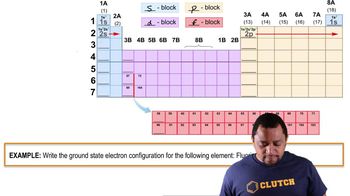
Electron Configuration

Electron configuration describes the distribution of electrons in an atom's orbitals. Understanding how electrons fill these orbitals according to the Aufbau principle, Pauli exclusion principle, and Hund's rule is essential for determining an element's magnetic properties. Elements with completely filled orbitals tend to be diamagnetic, while those with unpaired electrons are paramagnetic.
추천 영상:
가이드 코스
01:33
Electron Configuration Example

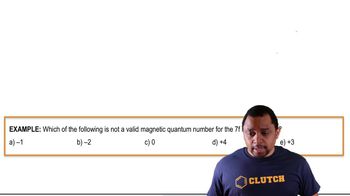
Magnetism in Atoms

Magnetism in atoms arises from the motion of electrons and their intrinsic spin. Diamagnetic materials have all their electrons paired, resulting in no net magnetic moment, while paramagnetic materials have unpaired electrons that contribute to a net magnetic moment. This distinction is crucial for identifying whether an element will be attracted to or repelled by a magnetic field.
추천 영상:
가이드 코스
00:59
Magnetic Quantum Example

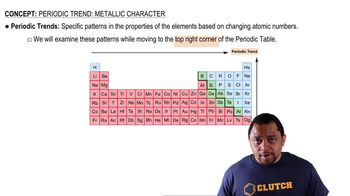
Periodic Trends

Periodic trends refer to the predictable patterns in elemental properties across the periodic table, including atomic size, ionization energy, and electronegativity. These trends help in understanding the behavior of elements, including their magnetic properties. For instance, as you move across a period, the number of protons increases, affecting electron configurations and, consequently, the magnetic characteristics of the elements.
추천 영상:
가이드 코스
00:38
Periodic Trends