Ch.8 - Periodic Properties of the Elements
Tro - Chemistry: A Molecular Approach 4th Edition
Tro4th EditionChemistry: A Molecular ApproachISBN: 9780134112831당신이 사용하는 게 아니라요?교과서 변경
8장, 문제 47b,d

Use the periodic table to determine each quantity. b. the number of 3d electrons in Cu d. the number of 4d electrons in Zr

검증된 단계별 안내
1
Step 1: Locate Copper (Cu) on the periodic table. Copper is in the 4th period and 11th group (or 1B in older notation).
Step 2: Identify the electron configuration of Copper. The electron configuration of Copper is [Ar] 4s2 3d9. However, Copper is one of the exceptions to the electron configuration rule. To stabilize the atom, one electron from the 4s orbital is moved to the 3d orbital, making the electron configuration [Ar] 4s1 3d10.
Step 3: Identify the number of 3d electrons. From the electron configuration, we can see that there are 10 electrons in the 3d orbital.

비슷한 문제에 대한 검증된 영상 답변:

이 영상 해법은 위 문제에 도움이 된다고 튜터들이 추천한 것입니다.
영상 길이:
1m
도움이 되었나요?

주요 개념

질문에 올바르게 답하기 위해 반드시 이해해야 하는 핵심 개념들은 다음과 같습니다.

Electron Configuration

Electron configuration describes the distribution of electrons in an atom's orbitals. For transition metals like copper (Cu), the electron configuration is crucial for understanding how many electrons occupy the 3d subshell. Copper has an atomic number of 29, leading to a configuration of [Ar] 3d10 4s1, indicating it has 10 electrons in the 3d subshell.
추천 영상:
가이드 코스
01:33
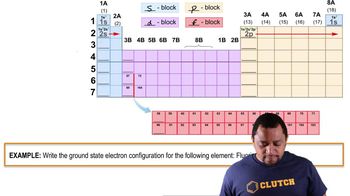
Electron Configuration Example

Transition Metals

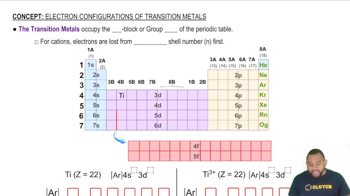
Transition metals are elements found in the d-block of the periodic table, characterized by their ability to form variable oxidation states and colored compounds. They typically have partially filled d orbitals, which play a significant role in their chemical properties. Understanding the behavior of transition metals, such as copper, is essential for determining the number of d electrons.
추천 영상:
가이드 코스
03:12
Transition Metals

Periodic Table Trends

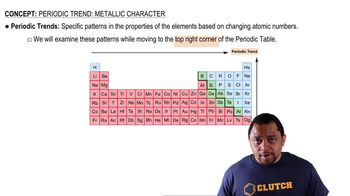
The periodic table organizes elements based on their atomic number and electron configurations, revealing trends in properties such as electronegativity, ionization energy, and atomic radius. By analyzing the position of copper in the periodic table, one can infer its electron configuration and the number of electrons in specific subshells, including the 3d subshell.
추천 영상:
가이드 코스
00:38
Periodic Trends