Ch.8 - Periodic Properties of the Elements
Tro - Chemistry: A Molecular Approach 4th Edition
Tro4th EditionChemistry: A Molecular ApproachISBN: 9780134112831당신이 사용하는 게 아니라요?교과서 변경
8장, 문제 22

Which of the transition elements in the first transition series have anomalous electron configurations?

검증된 단계별 안내
1
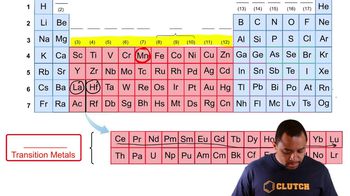
Understand that transition elements are those found in the d-block of the periodic table, specifically groups 3 to 12.
The first transition series includes elements from Scandium (Sc) to Zinc (Zn), with atomic numbers 21 to 30.
Recall that electron configurations are typically written by filling the lowest energy orbitals first, following the Aufbau principle, Hund's rule, and the Pauli exclusion principle.
Identify that anomalous electron configurations occur when electrons fill or half-fill d orbitals to achieve a more stable configuration, often seen in Chromium (Cr) and Copper (Cu) in the first transition series.
For Chromium, instead of the expected [Ar] 3d^4 4s^2, the configuration is [Ar] 3d^5 4s^1. For Copper, instead of [Ar] 3d^9 4s^2, the configuration is [Ar] 3d^10 4s^1. This is due to the extra stability associated with half-filled and fully filled d subshells.

비슷한 문제에 대한 검증된 영상 답변:

이 영상 해법은 위 문제에 도움이 된다고 튜터들이 추천한 것입니다.
영상 길이:
4m
도움이 되었나요?

주요 개념

질문에 올바르게 답하기 위해 반드시 이해해야 하는 핵심 개념들은 다음과 같습니다.

Transition Elements

Transition elements, or transition metals, are the d-block elements in the periodic table, characterized by their ability to form variable oxidation states and colored compounds. They include elements such as iron, copper, and nickel, which have partially filled d-orbitals. Understanding their electron configurations is crucial for predicting their chemical behavior and properties.
추천 영상:
가이드 코스
03:30
Transition Metals and Representative Elements

Electron Configuration

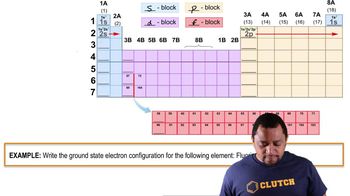
Electron configuration describes the distribution of electrons in an atom's orbitals. For transition metals, this involves filling the 3d and 4s orbitals. Anomalous electron configurations occur when electrons are promoted from the s-orbital to the d-orbital to achieve greater stability, often seen in elements like chromium and copper.
추천 영상:
가이드 코스
01:33
Electron Configuration Example

Anomalous Electron Configurations

Anomalous electron configurations refer to deviations from the expected order of electron filling in atoms. In transition metals, this often results in a more stable arrangement by having half-filled or fully filled d-orbitals. For example, chromium (Cr) has an electron configuration of [Ar] 3d5 4s1 instead of the expected [Ar] 3d4 4s2, highlighting the importance of stability in electron arrangements.
추천 영상:
가이드 코스
01:33
Electron Configuration Example