Ch.8 - Periodic Properties of the Elements
Tro - Chemistry: A Molecular Approach 4th Edition
Tro4th EditionChemistry: A Molecular ApproachISBN: 9780134112831당신이 사용하는 게 아니라요?교과서 변경
8장, 문제 41

Write the full electron configuration for each element. a. Si b. O c. K d. Ne

검증된 단계별 안내
1
Identify the atomic number of each element to determine the number of electrons: Si (14), O (8), K (19), Ne (10).
Recall the order of electron filling according to the Aufbau principle: 1s, 2s, 2p, 3s, 3p, 4s, 3d, 4p, etc.
For Si (Silicon), distribute 14 electrons: Fill 1s, 2s, 2p, 3s, and then 3p orbitals.
For O (Oxygen), distribute 8 electrons: Fill 1s, 2s, and then 2p orbitals.
For K (Potassium), distribute 19 electrons: Fill 1s, 2s, 2p, 3s, 3p, and then 4s orbitals. For Ne (Neon), distribute 10 electrons: Fill 1s, 2s, and then 2p orbitals.

비슷한 문제에 대한 검증된 영상 답변:

이 영상 해법은 위 문제에 도움이 된다고 튜터들이 추천한 것입니다.
영상 길이:
4m
도움이 되었나요?

주요 개념

질문에 올바르게 답하기 위해 반드시 이해해야 하는 핵심 개념들은 다음과 같습니다.

Electron Configuration

Electron configuration describes the distribution of electrons in an atom's orbitals. It follows the Aufbau principle, which states that electrons fill the lowest energy orbitals first, and is represented using a notation that includes the principal quantum number and the type of orbital (s, p, d, f). For example, the electron configuration of oxygen (O) is 1s² 2s² 2p⁴.
추천 영상:
가이드 코스
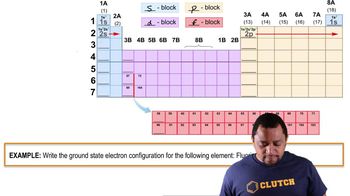
01:33
Electron Configuration Example

Periodic Table and Atomic Number

The periodic table organizes elements based on their atomic number, which is the number of protons in an atom's nucleus. This number determines the element's identity and influences its electron configuration. For instance, silicon (Si) has an atomic number of 14, indicating it has 14 electrons that fill its orbitals according to the rules of electron configuration.
추천 영상:
가이드 코스
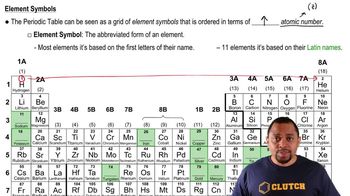
04:01
Periodic Table History

Valence Electrons

Valence electrons are the outermost electrons of an atom and are crucial for determining chemical reactivity and bonding behavior. The number of valence electrons can be inferred from the electron configuration, particularly from the highest principal energy level. For example, potassium (K) has one valence electron in its 4s orbital, which makes it highly reactive.
추천 영상:
가이드 코스
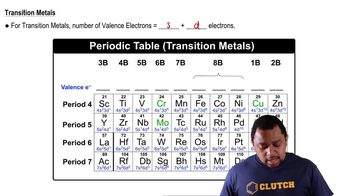
02:12
Transition Metals Valence Electrons