Ch.8 - Periodic Properties of the Elements
Tro - Chemistry: A Molecular Approach 4th Edition
Tro4th EditionChemistry: A Molecular ApproachISBN: 9780134112831당신이 사용하는 게 아니라요?교과서 변경
8장, 문제 67

Write orbital diagrams for each of these ions.Determine if the ion is diamagnetic or paramagnetic. a. V5+ b. Cr3+ c. Ni2+ d. Fe3+

검증된 단계별 안내
1
Identify the electron configuration of the neutral atom for each ion: V, Cr, Ni, and Fe.
Determine the number of electrons removed to form each ion: V^{5+}, Cr^{3+}, Ni^{2+}, and Fe^{3+}.
Write the electron configuration for each ion by removing electrons from the highest energy orbitals (usually starting with the s orbital, then the d orbital if necessary).
Draw the orbital diagrams for each ion, filling the orbitals according to Hund's rule and the Pauli exclusion principle.
Determine if the ion is diamagnetic (all electrons paired) or paramagnetic (one or more unpaired electrons) based on the orbital diagram.

비슷한 문제에 대한 검증된 영상 답변:

이 영상 해법은 위 문제에 도움이 된다고 튜터들이 추천한 것입니다.
영상 길이:
3m

주요 개념

질문에 올바르게 답하기 위해 반드시 이해해야 하는 핵심 개념들은 다음과 같습니다.

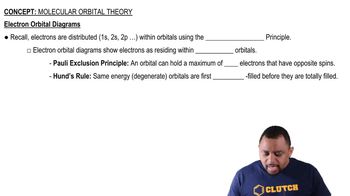
Orbital Diagrams

Orbital diagrams visually represent the distribution of electrons in an atom's orbitals. Each orbital can hold a maximum of two electrons with opposite spins, and the diagram helps illustrate how electrons fill these orbitals according to the Aufbau principle, Hund's rule, and the Pauli exclusion principle. Understanding how to construct these diagrams is essential for determining the electron configuration of ions.
추천 영상:
가이드 코스
01:16
Electron Orbital Diagrams

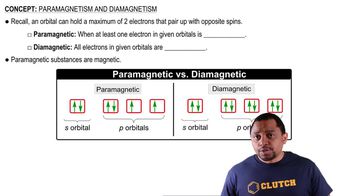
Diamagnetism vs. Paramagnetism

Diamagnetism and paramagnetism are two types of magnetic behavior in materials. Diamagnetic substances have all their electrons paired, resulting in no net magnetic moment and weak repulsion from magnetic fields. In contrast, paramagnetic substances have unpaired electrons, leading to a net magnetic moment and attraction to magnetic fields. Identifying whether an ion is diamagnetic or paramagnetic is crucial for understanding its chemical properties.
추천 영상:
가이드 코스
01:33
Paramagnetism vs Diamagnetism

Electron Configuration of Ions

The electron configuration of ions is derived from the electron configuration of the neutral atom, adjusted for the loss or gain of electrons. For cations, electrons are removed from the outermost orbitals first, which can affect the overall electron arrangement. Knowing how to write the electron configuration for ions like V<sup>5+</sup>, Cr<sup>3+</sup>, Ni<sup>2+</sup>, and Fe<sup>3+</sup> is vital for constructing their orbital diagrams and determining their magnetic properties.
추천 영상:
가이드 코스
00:35
Anion Electron Configuration