Ch.9 - Chemical Bonding I: The Lewis Model
Tro - Chemistry: A Molecular Approach 4th Edition
Tro4th EditionChemistry: A Molecular ApproachISBN: 9780134112831당신이 사용하는 게 아니라요?교과서 변경
9장, 문제 104

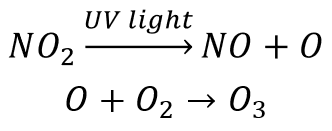
Free radicals are important in many environmentally significant reactions (see the Chemistry in the Environment box on free radicals in this chapter). For example, photochemical smog— smog that results from the action of sunlight on air pollutants— forms in part by these two steps:

The product of this reaction, ozone, is a pollutant in the lower atmosphere. (Upper atmospheric ozone is a natural part of the atmosphere that protects life on Earth from ultraviolet light.) Ozone is an eye and lung irritant and also accelerates the weathering of rubber products. Rewrite the given reactions using the Lewis structure of each reactant and product. Identify the free radicals.

검증된 단계별 안내
1
Identify the reactants and products in each reaction: \( \text{NO}_2 \rightarrow \text{NO} + \text{O} \) and \( \text{O} + \text{O}_2 \rightarrow \text{O}_3 \).
Draw the Lewis structure for each molecule: \( \text{NO}_2 \), \( \text{NO} \), \( \text{O} \), \( \text{O}_2 \), and \( \text{O}_3 \).
For \( \text{NO}_2 \), show the nitrogen atom bonded to two oxygen atoms with one unpaired electron on the nitrogen, indicating it is a free radical.
For \( \text{O} \), show the oxygen atom with two lone pairs and two unpaired electrons, indicating it is a free radical.
Identify the free radicals in the reactions: \( \text{NO}_2 \) and \( \text{O} \) are free radicals due to their unpaired electrons.

비슷한 문제에 대한 검증된 영상 답변:

이 영상 해법은 위 문제에 도움이 된다고 튜터들이 추천한 것입니다.
영상 길이:
4m

주요 개념

질문에 올바르게 답하기 위해 반드시 이해해야 하는 핵심 개념들은 다음과 같습니다.

Free Radicals

Free radicals are highly reactive species that contain unpaired electrons. They can initiate chain reactions in various chemical processes, including combustion and atmospheric reactions. In the context of the question, free radicals play a crucial role in the formation of ozone and other pollutants, as they can react with other molecules to produce new compounds.
추천 영상:
가이드 코스
01:51
Gibbs Free Energy of Reactions

Lewis Structures

Lewis structures are diagrams that represent the bonding between atoms in a molecule and the lone pairs of electrons that may exist. They help visualize the arrangement of electrons and the connectivity of atoms, which is essential for understanding chemical reactions. In this question, drawing Lewis structures for the reactants and products will clarify how free radicals are formed and how they interact.
추천 영상:
가이드 코스
04:28
Lewis Dot Structures: Ions

Photochemical Reactions

Photochemical reactions are chemical reactions that are initiated or accelerated by light, particularly ultraviolet (UV) light. In the case of photochemical smog, sunlight triggers the breakdown of nitrogen dioxide (NO2) into free radicals, which then participate in further reactions to produce ozone. Understanding these reactions is vital for grasping the environmental impact of pollutants.
추천 영상:
가이드 코스
01:30
Alcohol Reactions: Dehydration Reactions
관련 실천
교과서 질문

If hydrogen were used as a fuel, it could be burned according to this reaction: H2(g) + 1/2 O2(g) → H2O(g) Use average bond energies to calculate ΔHrxn for this reaction.

676
views

교과서 질문

Some theories of aging suggest that free radicals cause certain diseases and perhaps aging in general. As you know from the Lewis model, such molecules are not chemically stable and will quickly react with other molecules. According to certain theories, free radicals may attack molecules within the cell, such as DNA, changing them and causing cancer or other diseases. Free radicals may also attack molecules on the surfaces of cells, making them appear foreign to the body's immune system. The immune system then attacks the cells and destroys them, weakening the body. Draw Lewis structures for each free radical implicated in this theory of aging. d. CH3OO (unpaired electron on terminal oxygen)

580
views
교과서 질문

Some theories of aging suggest that free radicals cause certain diseases and perhaps aging in general. As you know from the Lewis model, such molecules are not chemically stable and will quickly react with other molecules. According to certain theories, free radicals may attack molecules within the cell, such as DNA, changing them and causing cancer or other diseases. Free radicals may also attack molecules on the surfaces of cells, making them appear foreign to the body's immune system. The immune system then attacks the cells and destroys them, weakening the body. Draw Lewis structures for each free radical implicated in this theory of aging. c. OH

585
views
교과서 질문

If hydrogen were used as a fuel, it could be burned according to this reaction: H2(g) + 1/2 O2(g) → H2O(g) Which fuel yields more energy per mole?

384
views
교과서 질문

If hydrogen were used as a fuel, it could be burned according to this reaction: H2(g) + 1/2 O2(g) → H2O(g) Use average bond energies to calculate ΔHrxn for the combustion of methane (CH4).

756
views