Ch.12 - Liquids, Solids & Intermolecular Forces
Tro - Chemistry: A Molecular Approach 5th Edition
Tro5th EditionChemistry: A Molecular ApproachISBN: 9780134874371당신이 사용하는 게 아니라요?교과서 변경
12장, 문제 67

How much energy is released when 65.8 g of water freezes?

검증된 단계별 안내
1
Determine the molar mass of water (H2O). The molar mass of hydrogen (H) is approximately 1.01 g/mol and oxygen (O) is approximately 16.00 g/mol. Therefore, the molar mass of water is (2 \(\times\) 1.01) + 16.00 = 18.02 g/mol.
Calculate the number of moles of water present in 65.8 g. Use the formula: \(\text{moles}\) = \(\frac{\text{mass (g)}\)}{\(\text{molar mass (g/mol)}\)}.
Find the heat of fusion of water, which is the amount of energy needed to freeze or melt water. The heat of fusion for water is approximately 334 J/g.
Calculate the total energy released when the water freezes by multiplying the number of moles by the heat of fusion per gram and the molar mass of water. Use the formula: \(\text{Energy released (J)}\) = \(\text{moles}\) \(\times\) \(\text{heat of fusion (J/g)}\) \(\times\) \(\text{molar mass (g/mol)}\).
The result from the previous step gives the total energy released in Joules when 65.8 g of water freezes.

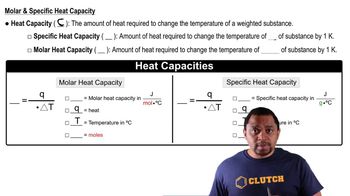
비슷한 문제에 대한 검증된 영상 답변:

이 영상 해법은 위 문제에 도움이 된다고 튜터들이 추천한 것입니다.
영상 길이:
2m
도움이 되었나요?

주요 개념

질문에 올바르게 답하기 위해 반드시 이해해야 하는 핵심 개념들은 다음과 같습니다.

Heat of Fusion

The heat of fusion is the amount of energy required to change a substance from solid to liquid at its melting point, or vice versa. For water, this value is approximately 334 J/g. When water freezes, it releases this amount of energy per gram, which is crucial for calculating the total energy released during the freezing process.
추천 영상:

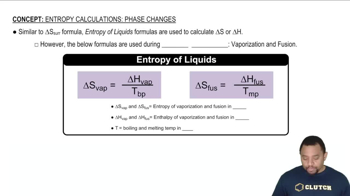
Phase Changes

Phase changes refer to the transitions between solid, liquid, and gas states of matter. Freezing is the process where a liquid turns into a solid, and it involves the release of energy as the molecules lose kinetic energy and arrange into a more ordered structure. Understanding phase changes is essential for calculating energy changes in substances.
추천 영상:
가이드 코스
01:46
Entropy in Phase Changes

Mass-Energy Relationship

The mass-energy relationship in thermodynamics indicates that the amount of energy involved in a phase change is directly proportional to the mass of the substance undergoing the change. In this case, the energy released when water freezes can be calculated by multiplying the mass of the water by the heat of fusion, allowing for precise energy calculations.
추천 영상:
가이드 코스
04:12
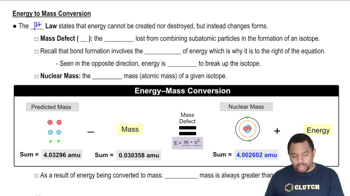
Energy to Mass Conversion