Determine whether each cation is acidic or pH-neutral. For those cations that are acidic, write an equation that shows how the cation acts as an acid. d. CH2NH3+
Ch.17 - Acids and Bases
17장, 문제 100a,b,c
Determine whether each cation is acidic or pH-neutral. For each cation that is acidic, write an equation that shows how the cation acts as an acid. a. Sr2+ b. Mn3+ c. C5H5NH+
검증된 단계별 안내1
Step 1: Understand the concept of acidic and pH-neutral cations. Acidic cations are typically those that can donate a proton (H+) or increase the concentration of H+ in solution, often by reacting with water. pH-neutral cations do not affect the pH of the solution significantly.
Step 2: Analyze Sr^{2+}. Strontium ion (Sr^{2+}) is a Group 2 metal cation. Group 2 metal cations are generally considered pH-neutral because they do not hydrolyze in water to produce H+ ions.
Step 3: Analyze Mn^{3+}. Manganese(III) ion (Mn^{3+}) is a transition metal cation. Transition metal cations with a high positive charge can act as acids by hydrolyzing in water. Write the hydrolysis equation: Mn^{3+} + H_2O \(\rightarrow\) Mn(OH)^{2+} + H^+.
Step 4: Analyze C_5H_5NH^+. Pyridinium ion (C_5H_5NH^+) is the conjugate acid of pyridine (C_5H_5N). It can donate a proton to water, making it acidic. Write the equation: C_5H_5NH^+ + H_2O \(\rightarrow\) C_5H_5N + H_3O^+.
Step 5: Summarize the findings. Sr^{2+} is pH-neutral, Mn^{3+} is acidic and hydrolyzes to produce H^+, and C_5H_5NH^+ is acidic and donates a proton to form hydronium ion (H_3O^+).
주요 개념
질문에 올바르게 답하기 위해 반드시 이해해야 하는 핵심 개념들은 다음과 같습니다.
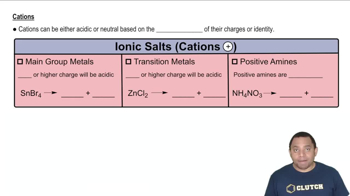
Acidic Cations
Acidic cations are positively charged ions that can donate protons (H+) in solution, thereby lowering the pH. These cations typically arise from metals with high charge density, which can polarize water molecules and facilitate the release of protons. Understanding the nature of these cations is crucial for determining their acidic behavior in aqueous solutions.
추천 영상:
가이드 코스
Cation Acidity in Salts
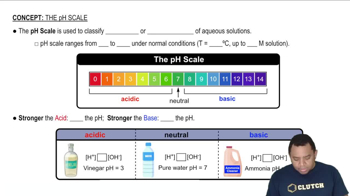
pH and Neutrality
pH is a measure of the hydrogen ion concentration in a solution, indicating its acidity or basicity. A pH of 7 is considered neutral, while values below 7 indicate acidity and above 7 indicate basicity. Cations that do not significantly affect the concentration of H+ ions in solution are classified as pH-neutral, meaning they do not alter the pH of the solution.
추천 영상:
가이드 코스
The pH Scale
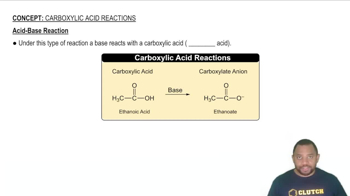
Equilibrium and Acid-Base Reactions
Acid-base reactions often involve the transfer of protons between species, establishing an equilibrium between reactants and products. For acidic cations, the reaction can be represented by an equation showing the cation donating a proton to water, forming hydronium ions (H3O+). Understanding this equilibrium is essential for predicting the behavior of cations in solution.
추천 영상:
가이드 코스
Acid-Base Reaction
관련 실천
교과서 질문
548
views
교과서 질문
Determine whether each cation is acidic or pH-neutral. For those cations that are acidic, write an equation that shows how the cation acts as an acid. b. Na+
382
views
교과서 질문
Determine whether each cation is acidic or pH-neutral. For those cations that are acidic, write an equation that shows how the cation acts as an acid. c. Co3+
672
views
교과서 질문
Determine whether each cation is acidic or pH-neutral. For each cation that is acidic, write an equation that shows how the cation acts as an acid. d. Li+
1241
views
교과서 질문
Determine if each salt will form a solution that is acidic, basic, or pH-neutral. a. Al(NO3)3
609
views
교과서 질문
Determine if each salt will form a solution that is acidic, basic, or pH-neutral. e. C6H5NH3NO2
1961
views