Ch.20 - Electrochemistry
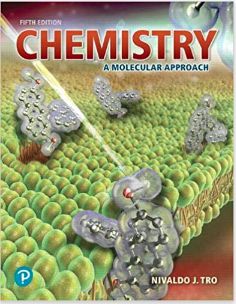
Tro - Chemistry: A Molecular Approach 5th Edition
Tro5th EditionChemistry: A Molecular ApproachISBN: 9780134874371당신이 사용하는 게 아니라요?교과서 변경
20장, 문제 59

Determine whether or not each metal dissolves in 1 M HNO3. For those metals that do dissolve, write a balanced redox reaction showing what happens when the metal dissolves. a. Cu b. Au

검증된 단계별 안내
1
Identify the standard reduction potential of HNO3 and the metal involved. For HNO3, the NO3- ion is reduced to NO2, and for Cu, the Cu metal is oxidized to Cu2+.
Compare the standard reduction potentials. The metal will dissolve if its oxidation potential is higher than the reduction potential of the nitrate ion in HNO3.
Write the half-reactions for the oxidation of Cu and the reduction of NO3-. For Cu: Cu(s) → Cu2+(aq) + 2e-. For NO3-: NO3-(aq) + 2H+(aq) + e- → NO2(g) + H2O(l).
Balance the electrons in the half-reactions. Multiply the Cu oxidation reaction by 1 and the NO3- reduction reaction by 2 to balance the number of electrons transferred.
Add the balanced half-reactions together to get the overall redox reaction: 3Cu(s) + 2NO3-(aq) + 8H+(aq) → 3Cu2+(aq) + 2NO2(g) + 4H2O(l).

비슷한 문제에 대한 검증된 영상 답변:

이 영상 해법은 위 문제에 도움이 된다고 튜터들이 추천한 것입니다.
영상 길이:
6m
도움이 되었나요?

주요 개념

질문에 올바르게 답하기 위해 반드시 이해해야 하는 핵심 개념들은 다음과 같습니다.

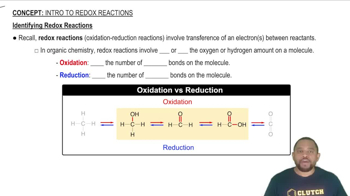
Redox Reactions

Redox reactions involve the transfer of electrons between substances, leading to changes in oxidation states. In these reactions, one species is oxidized (loses electrons) while another is reduced (gains electrons). Understanding redox processes is crucial for predicting how metals interact with acids, such as nitric acid (HNO3), which can act as both an oxidizing agent and a source of protons.
추천 영상:
가이드 코스
03:12
Identifying Redox Reactions

Metal Reactivity

The reactivity of metals is determined by their ability to lose electrons and form cations. This property is influenced by factors such as ionization energy and electronegativity. In the context of HNO3, more reactive metals will dissolve readily, while less reactive metals, like copper (Cu), may not react significantly unless specific conditions are met.
추천 영상:
가이드 코스
03:12
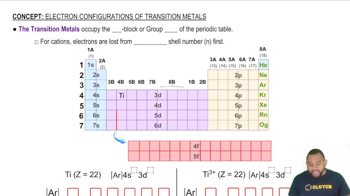
Transition Metals

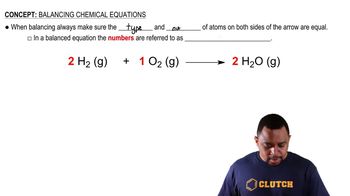
Balanced Chemical Equations

A balanced chemical equation represents a chemical reaction with equal numbers of each type of atom on both sides of the equation. Balancing is essential to accurately depict the conservation of mass and charge during a reaction. For metals dissolving in acids, writing a balanced equation helps illustrate the stoichiometry of the reactants and products involved in the redox process.
추천 영상:
가이드 코스
01:32
Balancing Chemical Equations