Combustion analysis of naphthalene, a hydrocarbon used in mothballs, produces 8.80 g CO2 and 1.44 g H2O. Calculate the empirical formula of naphthalene.
Ch.3 - Molecules and Compounds
3장, 문제 101
Classify each compound as organic or inorganic: a. CaCO3 b. C4H8 c. C4H6O6 d. LiF
검증된 단계별 안내1
Identify the definition of organic and inorganic compounds. Organic compounds primarily contain carbon atoms bonded to hydrogen atoms, often with other elements like oxygen, nitrogen, etc. Inorganic compounds typically do not have carbon-hydrogen bonds.
Examine compound a: \( \text{CaCO}_3 \). This compound contains calcium, carbon, and oxygen. It is a salt and does not have carbon-hydrogen bonds, classifying it as inorganic.
Examine compound b: \( \text{C}_4\text{H}_8 \). This compound consists solely of carbon and hydrogen, which are typical of organic compounds. Therefore, it is classified as organic.
Examine compound c: \( \text{C}_4\text{H}_6\text{O}_6 \). This compound contains carbon, hydrogen, and oxygen. The presence of carbon and hydrogen together suggests it is an organic compound.
Examine compound d: \( \text{LiF} \). This compound consists of lithium and fluorine, with no carbon present. It is classified as inorganic.
주요 개념
질문에 올바르게 답하기 위해 반드시 이해해야 하는 핵심 개념들은 다음과 같습니다.
Organic Compounds
Organic compounds are primarily composed of carbon atoms, often in combination with hydrogen, oxygen, nitrogen, and other elements. They typically contain carbon-hydrogen (C-H) bonds and are associated with living organisms. Examples include hydrocarbons and functional groups like alcohols and acids.
추천 영상:
가이드 코스
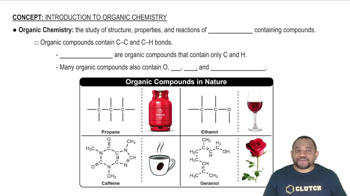
Introduction to Organic Chemistry
Inorganic Compounds
Inorganic compounds generally do not contain carbon-hydrogen bonds and include a wide range of substances such as minerals, metals, and salts. They can be composed of metals, nonmetals, and metalloids, and often have ionic or covalent bonds. Examples include sodium chloride (NaCl) and calcium carbonate (CaCO3).
추천 영상:
가이드 코스
Ionic Compounds Naming
Classification Criteria
The classification of compounds as organic or inorganic is based on their molecular structure and composition. Organic compounds must contain carbon and typically hydrogen, while inorganic compounds may contain carbon but lack C-H bonds. This distinction is crucial for understanding chemical behavior and reactivity.
추천 영상:
가이드 코스
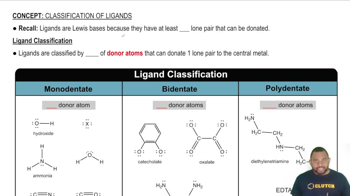
Ligand Classification
관련 실천
교과서 질문
1868
views
교과서 질문
Classify each hydrocarbon as an alkane, alkene, or alkyne. a. HC≡CH
193
views
교과서 질문
Tartaric acid is the white, powdery substance that coats tart candies such as Sour Patch Kids. Combustion analysis of a 12.01-g sample of tartaric acid—which contains only carbon, hydrogen, and oxygen—produces 14.08 g CO2 and 4.32 g H2O. Determine the empirical formula of tartaric acid.
2236
views
교과서 질문
The foul odor of rancid butter is due largely to butyric acid, a compound containing carbon, hydrogen, and oxygen. Combustion analysis of a 4.30-g sample of butyric acid produces 8.59 g CO2 and 3.52 g H2O. Determine the empirical formula of butyric acid.
2387
views
교과서 질문
Classify each hydrocarbon as an alkane, alkene, or alkyne. a. H2C=CH−CH3 b. H3C−CH2−CH3 c. HC≡C−CH3 d. H3C−CH2−CH2−CH3
290
views