A 55.0-mL sample of a 0.102 M potassium sulfate solution is mixed with 35.0 mL of a 0.114 M lead(II) acetate solution and this precipitation reaction occurs: K2SO4(aq) + Pb(C2H3O2)2(aq) → 2 KC2H3O2(aq) + PbSO4(s) The solid PbSO4 is collected, dried, and found to have a mass of 1.01 g. Determine the limiting reactant, theoretical yield, percent yield.
Ch.5 - Introduction to Solutions and Aqueous Solutions
5장, 문제 37c
A 25.0-mL sample of a 1.20 M potassium chloride solution is mixed with 15.0 mL of a 0.900 M lead(II) nitrate solution and this precipitation reaction occurs: 2 KCl(aq) + Pb(NO3)2(aq) → PbCl2(s) + 2 KNO3(aq) The solid PbCl2 is collected, dried, and found to have a mass of 2.45 g. Determine the the percent yield.
검증된 단계별 안내1
Calculate the moles of KCl in the 25.0 mL of 1.20 M solution using the formula: \( \text{moles} = \text{molarity} \times \text{volume in liters} \).
Calculate the moles of Pb(NO_3)_2 in the 15.0 mL of 0.900 M solution using the same formula: \( \text{moles} = \text{molarity} \times \text{volume in liters} \).
Determine the limiting reactant by comparing the mole ratio from the balanced equation: 2 KCl reacts with 1 Pb(NO_3)_2.
Calculate the theoretical yield of PbCl_2 using the moles of the limiting reactant and the stoichiometry of the reaction.
Calculate the percent yield using the formula: \( \text{percent yield} = \left( \frac{\text{actual yield}}{\text{theoretical yield}} \right) \times 100\).

비슷한 문제에 대한 검증된 영상 답변:
이 영상 해법은 위 문제에 도움이 된다고 튜터들이 추천한 것입니다.
도움이 되었나요?
주요 개념
질문에 올바르게 답하기 위해 반드시 이해해야 하는 핵심 개념들은 다음과 같습니다.
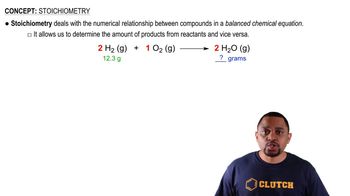
Stoichiometry
Stoichiometry is the calculation of reactants and products in chemical reactions based on the balanced chemical equation. It allows us to determine the amount of product formed from given quantities of reactants. In this case, stoichiometry is essential to find the theoretical yield of lead(II) chloride (PbCl2) from the initial concentrations and volumes of potassium chloride (KCl) and lead(II) nitrate (Pb(NO3)2).
추천 영상:
가이드 코스
Stoichiometry Concept
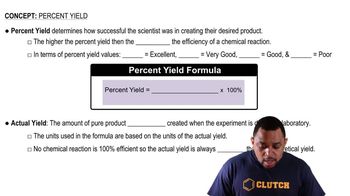
Percent Yield
Percent yield is a measure of the efficiency of a chemical reaction, calculated by comparing the actual yield of a product to the theoretical yield. It is expressed as a percentage and is calculated using the formula: (actual yield / theoretical yield) × 100%. In this problem, the actual yield is the mass of PbCl2 collected, while the theoretical yield is determined from stoichiometric calculations.
추천 영상:
가이드 코스
Percent Yield in Reactions
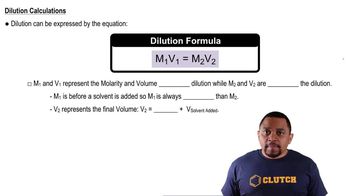
Molarity and Dilution
Molarity (M) is a concentration unit defined as the number of moles of solute per liter of solution. It is crucial for determining the amount of reactants in a solution. In this question, the molarity of KCl and Pb(NO3)2 solutions is used to calculate the moles of each reactant before the reaction occurs, which is necessary for stoichiometric calculations and determining the theoretical yield.
추천 영상:
가이드 코스
Dilution Equation
관련 실천
교과서 질문
4877
views
4
rank
1
comments
교과서 질문
What is the molarity of ZnCl2 that forms when 25.0 g of zinc completely reacts with CuCl2 according to the following reaction? Assume a final volume of 275 mL. Zn(s) + CuCl2(aq) → ZnCl2(aq) + Cu(s)
2834
views
1
rank
교과서 질문
Classify each compound as a strong electrolyte or nonelectrolyte. a. MgBr2 b. C12H22O11 c. Na2CO3 d. KOH
2324
views
교과서 질문
For each compound (all water soluble), would you expect the resulting aqueous solution to conduct electrical current? a. CsCl b. CH3OH c. Ca(NO2)2 d. C6H12O6
1986
views
1
rank
교과서 질문
Consider the reaction: Li2S(aq) + Co(NO3)2(aq) → 2 LiNO3(aq) + CoS(s) What volume of 0.150 M Li2S solution is required to completely react with 125 mL of 0.150 M Co(NO3)2?
2484
views
