Ch.5 - Introduction to Solutions and Aqueous Solutions
Tro - Chemistry: A Molecular Approach 5th Edition
Tro5th EditionChemistry: A Molecular ApproachISBN: 9780134874371당신이 사용하는 게 아니라요?교과서 변경
5장, 문제 38

A 55.0-mL sample of a 0.102 M potassium sulfate solution is mixed with 35.0 mL of a 0.114 M lead(II) acetate solution and this precipitation reaction occurs: K2SO4(aq) + Pb(C2H3O2)2(aq) → 2 KC2H3O2(aq) + PbSO4(s) The solid PbSO4 is collected, dried, and found to have a mass of 1.01 g. Determine the limiting reactant, theoretical yield, percent yield.

검증된 단계별 안내
1
Determine the moles of K_2SO_4: Use the formula \( \text{moles} = \text{molarity} \times \text{volume in liters} \). Convert 55.0 mL to liters and multiply by 0.102 M to find the moles of K_2SO_4.
Determine the moles of Pb(C_2H_3O_2)_2: Similarly, convert 35.0 mL to liters and multiply by 0.114 M to find the moles of Pb(C_2H_3O_2)_2.
Identify the limiting reactant: Use the stoichiometry of the balanced equation. Compare the mole ratio of K_2SO_4 to Pb(C_2H_3O_2)_2 (1:1) to determine which reactant is limiting.
Calculate the theoretical yield of PbSO_4: Use the moles of the limiting reactant to find the moles of PbSO_4 produced, using the 1:1 mole ratio from the balanced equation. Then, convert moles of PbSO_4 to grams using its molar mass.
Calculate the percent yield: Use the formula \( \text{percent yield} = \left( \frac{\text{actual yield}}{\text{theoretical yield}} \right) \times 100\% \). Substitute the actual yield (1.01 g) and the theoretical yield calculated in the previous step.

비슷한 문제에 대한 검증된 영상 답변:

이 영상 해법은 위 문제에 도움이 된다고 튜터들이 추천한 것입니다.
영상 길이:
6m
도움이 되었나요?

주요 개념

질문에 올바르게 답하기 위해 반드시 이해해야 하는 핵심 개념들은 다음과 같습니다.

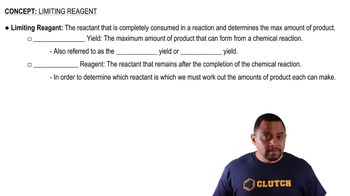
Limiting Reactant

The limiting reactant is the substance that is completely consumed first in a chemical reaction, thus determining the maximum amount of product that can be formed. To identify it, one must compare the mole ratios of the reactants based on the balanced chemical equation and the initial amounts of each reactant. The reactant that produces the least amount of product is the limiting reactant.
추천 영상:
가이드 코스
01:30
Limiting Reagent Concept

Theoretical Yield

The theoretical yield is the maximum amount of product that can be generated from a given amount of reactants, calculated using stoichiometry based on the balanced chemical equation. It assumes complete conversion of the limiting reactant into product without any losses. This value is essential for determining the efficiency of a reaction when compared to the actual yield obtained.
추천 영상:
가이드 코스
03:09
Percent Yield in Reactions

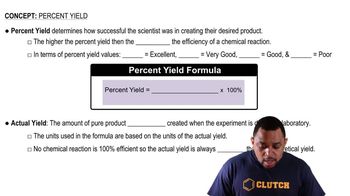
Percent Yield

Percent yield is a measure of the efficiency of a chemical reaction, calculated by dividing the actual yield of the product by the theoretical yield and multiplying by 100. It provides insight into how much of the expected product was actually produced in the experiment. A percent yield less than 100% indicates that some reactants did not convert to products, which can be due to various factors such as incomplete reactions or losses during processing.
추천 영상:
가이드 코스
03:09
Percent Yield in Reactions