Determine whether each transition in the hydrogen atom corresponds to absorption or emission of energy. a. n = 3 → n = 1 b. n = 2 → n = 4 c. n = 4 → n = 3
Ch.8 - The Quantum-Mechanical Model of the Atom
8장, 문제 67
According to the quantum-mechanical model for the hydrogen atom, which electron transition produces light with the longer wavelength: 2p to 1s or 3p to 1s?
검증된 단계별 안내1
Identify the concept of electron transitions and how they relate to the emission of light. In the hydrogen atom, when an electron transitions from a higher energy level to a lower one, it emits a photon of light.
Recall that the energy of the emitted photon is related to the difference in energy levels between the initial and final states. The greater the energy difference, the shorter the wavelength of the emitted light.
Use the Rydberg formula to calculate the energy difference for each transition: \( \Delta E = R_H \left( \frac{1}{n_1^2} - \frac{1}{n_2^2} \right) \), where \( R_H \) is the Rydberg constant, \( n_1 \) is the principal quantum number of the lower energy level, and \( n_2 \) is the principal quantum number of the higher energy level.
Calculate the energy difference for the 2p to 1s transition: \( n_1 = 1 \) and \( n_2 = 2 \).
Calculate the energy difference for the 3p to 1s transition: \( n_1 = 1 \) and \( n_2 = 3 \). Compare the energy differences to determine which transition emits light with a longer wavelength.
주요 개념
질문에 올바르게 답하기 위해 반드시 이해해야 하는 핵심 개념들은 다음과 같습니다.
Quantum Mechanical Model
The quantum mechanical model describes the behavior of electrons in atoms as wave functions rather than fixed orbits. It incorporates principles of quantum mechanics, such as quantization of energy levels, which dictate that electrons can only occupy certain energy states. This model is essential for understanding electron transitions and the emission of light in atoms.
추천 영상:
가이드 코스
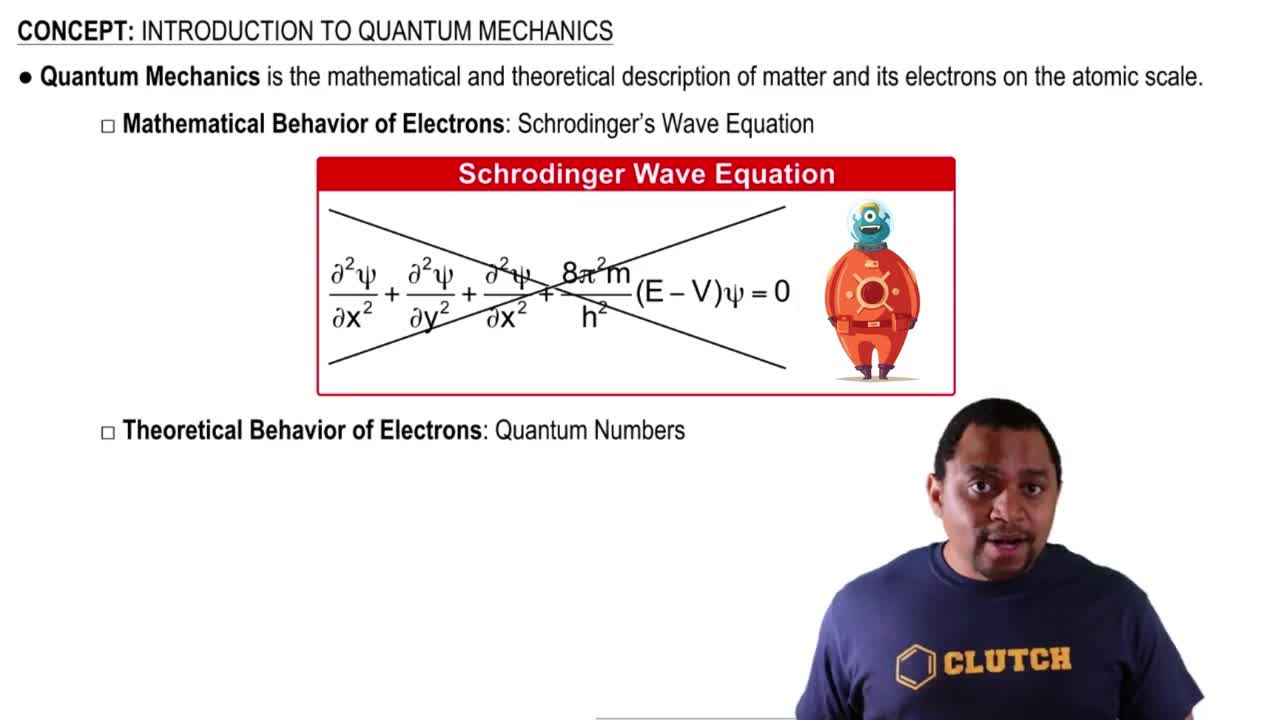
Introduction to Quantum Mechanics
Electron Transitions
Electron transitions refer to the movement of electrons between different energy levels within an atom. When an electron moves from a higher energy level to a lower one, it releases energy in the form of light. The energy difference between these levels determines the wavelength of the emitted light, with larger energy differences corresponding to shorter wavelengths.
추천 영상:
가이드 코스
Electron Configurations Of Transition Metals Example
Wavelength and Energy Relationship
The relationship between wavelength and energy is described by the equation E = hc/λ, where E is energy, h is Planck's constant, c is the speed of light, and λ is the wavelength. This inverse relationship means that longer wavelengths correspond to lower energy transitions. Thus, to determine which transition produces light with a longer wavelength, one must compare the energy differences of the transitions.
추천 영상:
가이드 코스
Frequency-Wavelength Relationship
관련 실천
교과서 질문
3571
views
3
rank
교과서 질문
According to the quantum-mechanical model for the hydrogen atom, which electron transition produces light with the longer wavelength: 3p → 2s or 4p → 3p?
1091
views
2
comments
교과서 질문
Calculate the frequency of the light emitted when an electron in a hydrogen atom makes each transition: a. n = 4 → n = 3 b. n = 5 → n = 1 c. n = 5 → n = 4 d. n = 6 → n = 5
8404
views
1
rank
교과서 질문
Calculate the wavelength of the light emitted when an electron in a hydrogen atom makes each transition and indicate the region of the electromagnetic spectrum (infrared, visible, ultraviolet, etc.) where the light is found. a. n = 2 → n = 1 b. n = 3 → n = 1 c. n = 4 → n = 2 d. n = 5 → n = 2
2102
views
교과서 질문
Sketch the 3d orbitals. How do the 4d orbitals differ from the 3d orbitals?
1426
views