Ch.8 - The Quantum-Mechanical Model of the Atom
Tro - Chemistry: A Molecular Approach 5th Edition
Tro5th EditionChemistry: A Molecular ApproachISBN: 9780134874371당신이 사용하는 게 아니라요?교과서 변경
8장, 문제 66

Determine whether each transition in the hydrogen atom corresponds to absorption or emission of energy. a. n = 3 → n = 1 b. n = 2 → n = 4 c. n = 4 → n = 3

검증된 단계별 안내
1
1. The energy levels of an atom are quantized, meaning they are discrete rather than continuous. In the case of a hydrogen atom, these energy levels are represented by the principal quantum number 'n'. The higher the value of 'n', the higher the energy level of the electron.
2. When an electron transitions from a higher energy level to a lower energy level (i.e., 'n' decreases), energy is emitted. This is because the electron loses energy in the form of light to move to a lower energy level.
3. Conversely, when an electron transitions from a lower energy level to a higher energy level (i.e., 'n' increases), energy is absorbed. This is because the electron needs to gain energy in the form of light to move to a higher energy level.
4. Therefore, for transition a (n = 3 to n = 1), energy is emitted because 'n' decreases. For transition b (n = 2 to n = 4), energy is absorbed because 'n' increases. For transition c (n = 4 to n = 3), energy is emitted because 'n' decreases.
5. Remember, the energy of the light emitted or absorbed during these transitions corresponds to the difference in energy between the two energy levels. This can be calculated using the Rydberg formula if needed.

비슷한 문제에 대한 검증된 영상 답변:

이 영상 해법은 위 문제에 도움이 된다고 튜터들이 추천한 것입니다.
도움이 되었나요?

주요 개념

질문에 올바르게 답하기 위해 반드시 이해해야 하는 핵심 개념들은 다음과 같습니다.

Energy Levels in Atoms

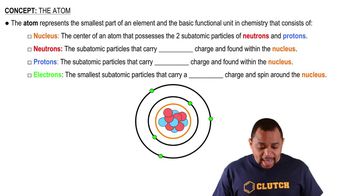
In an atom, electrons occupy specific energy levels or shells, denoted by quantum numbers (n). The energy levels are quantized, meaning electrons can only exist at certain distances from the nucleus. When an electron transitions between these levels, it either absorbs or emits energy, depending on whether it moves to a higher or lower energy level.
추천 영상:

Absorption and Emission of Energy

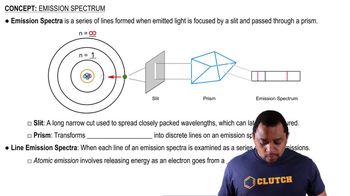
Absorption occurs when an electron gains energy and moves to a higher energy level (higher n value), while emission occurs when an electron loses energy and falls to a lower energy level (lower n value). The energy change associated with these transitions corresponds to the difference in energy between the two levels, often represented by the equation E = hf, where E is energy, h is Planck's constant, and f is frequency.
추천 영상:
가이드 코스
01:51
Emission Spectra

Quantum Transitions in Hydrogen

In the hydrogen atom, transitions between energy levels can be predicted using the Rydberg formula, which calculates the wavelengths of emitted or absorbed light. For example, a transition from n = 3 to n = 1 involves emission of energy, while a transition from n = 2 to n = 4 involves absorption. Understanding these transitions is crucial for interpreting spectral lines and the behavior of hydrogen in various energy states.
추천 영상:
가이드 코스
01:05
Hydrogen Compounds Example