Ch.12 - Liquids, Solids & Intermolecular Forces
Tro - Chemistry: A Molecular Approach 6th Edition
Tro6th EditionChemistry: A Molecular ApproachISBN: 9780137832217당신이 사용하는 게 아니라요?교과서 변경
12장, 문제 41d

Determine the kinds of intermolecular forces that are present in each element or compound. d. CH3OH

검증된 단계별 안내
1
Identify the molecular structure of CH_3OH, which is methanol, consisting of a hydroxyl group (-OH) attached to a methyl group (CH_3).
Recognize that methanol is a polar molecule due to the difference in electronegativity between the oxygen and hydrogen atoms in the hydroxyl group, leading to a dipole moment.
Determine that hydrogen bonding is present because methanol contains an -OH group, where the hydrogen atom is bonded to a highly electronegative oxygen atom, allowing for hydrogen bonds with other methanol molecules.
Identify that dipole-dipole interactions are also present due to the polar nature of the methanol molecule, where the positive end of one molecule is attracted to the negative end of another.
Acknowledge that London dispersion forces (also known as van der Waals forces) are present in all molecules, including methanol, due to the temporary dipoles that occur as electrons move around the nucleus.

비슷한 문제에 대한 검증된 영상 답변:

이 영상 해법은 위 문제에 도움이 된다고 튜터들이 추천한 것입니다.
영상 길이:
24s
도움이 되었나요?

주요 개념

질문에 올바르게 답하기 위해 반드시 이해해야 하는 핵심 개념들은 다음과 같습니다.

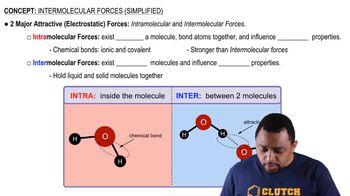
Intermolecular Forces

Intermolecular forces are the attractive forces between molecules that influence physical properties such as boiling and melting points. These forces include hydrogen bonding, dipole-dipole interactions, and London dispersion forces. Understanding these forces is crucial for predicting the behavior of substances in different states of matter.
추천 영상:
가이드 코스
01:59
Intermolecular vs Intramolecular Forces

Hydrogen Bonding

Hydrogen bonding is a specific type of strong dipole-dipole interaction that occurs when hydrogen is covalently bonded to highly electronegative atoms like oxygen, nitrogen, or fluorine. In the case of CH₃OH (methanol), the presence of the hydroxyl (-OH) group allows for significant hydrogen bonding, which greatly affects its physical properties, such as its relatively high boiling point.
추천 영상:
가이드 코스
01:22
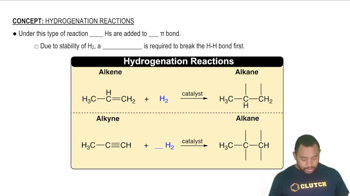
Hydrogenation Reactions

Polarity

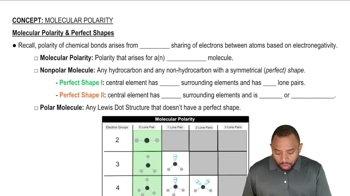
Polarity refers to the distribution of electrical charge over the atoms in a molecule. A polar molecule has a significant difference in electronegativity between its atoms, leading to a dipole moment. In CH₃OH, the oxygen atom is more electronegative than the carbon and hydrogen atoms, creating a polar molecule that can engage in hydrogen bonding and dipole-dipole interactions.
추천 영상:
가이드 코스
02:38
Molecular Polarity