Ch.12 - Liquids, Solids & Intermolecular Forces
Tro - Chemistry: A Molecular Approach 6th Edition
Tro6th EditionChemistry: A Molecular ApproachISBN: 9780137832217당신이 사용하는 게 아니라요?교과서 변경
12장, 문제 42d

Determine the kinds of intermolecular forces that are present in each element or compound. d. N2

검증된 단계별 안내
1
Identify the type of molecule: N_2 is a diatomic molecule composed of two nitrogen atoms.
Determine the polarity of the molecule: N_2 is a nonpolar molecule because the two nitrogen atoms have the same electronegativity, resulting in an equal sharing of electrons.
Recognize the types of intermolecular forces: Nonpolar molecules like N_2 primarily exhibit London dispersion forces.
Understand London dispersion forces: These are weak intermolecular forces arising from temporary dipoles that occur when electron clouds fluctuate momentarily.
Conclude the analysis: The only intermolecular force present in N_2 is London dispersion forces.

비슷한 문제에 대한 검증된 영상 답변:

이 영상 해법은 위 문제에 도움이 된다고 튜터들이 추천한 것입니다.
영상 길이:
50s
도움이 되었나요?

주요 개념

질문에 올바르게 답하기 위해 반드시 이해해야 하는 핵심 개념들은 다음과 같습니다.

Intermolecular Forces

Intermolecular forces are the attractive forces between molecules that influence physical properties such as boiling and melting points. These forces can be categorized into several types, including hydrogen bonding, dipole-dipole interactions, and London dispersion forces. Understanding these forces is crucial for predicting the behavior of substances in different states of matter.
추천 영상:
가이드 코스
01:59
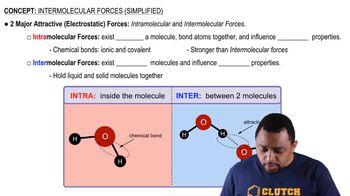
Intermolecular vs Intramolecular Forces

London Dispersion Forces

London dispersion forces are a type of intermolecular force that arise from temporary fluctuations in electron density within molecules, leading to the formation of instantaneous dipoles. These forces are present in all molecules, regardless of polarity, and are particularly significant in nonpolar substances like nitrogen gas (N2). The strength of these forces increases with the size and polarizability of the molecules involved.
추천 영상:
가이드 코스
06:44
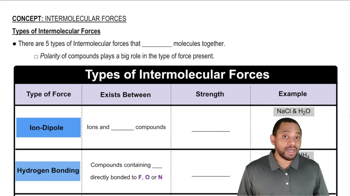
Types of Intermolecular Forces

Molecular Structure of N2

Nitrogen gas (N2) consists of two nitrogen atoms bonded by a triple covalent bond, resulting in a diatomic, nonpolar molecule. Due to its nonpolar nature, N2 does not exhibit dipole-dipole interactions or hydrogen bonding, making London dispersion forces the only type of intermolecular force present. This understanding helps explain the low boiling point and gas state of nitrogen at room temperature.
추천 영상:
가이드 코스
02:08
Molecular Formula