A buffer contains significant amounts of acetic acid and sodium acetate. Write equations showing how this buffer neutralizes added acid and added base.
Ch.18 - Aqueous Ionic Equilibrium

18장, 문제 33c
Solve an equilibrium problem (using an ICE table) to calculate the pH of each solution. c. a mixture that is 0.15 M in HF and 0.15 M in NaF
검증된 단계별 안내1
Identify the components of the solution: HF is a weak acid and NaF is its conjugate base, making this a buffer solution.
Write the equilibrium expression for the dissociation of HF: \( \text{HF} \rightleftharpoons \text{H}^+ + \text{F}^- \).
Set up an ICE table (Initial, Change, Equilibrium) to determine the concentrations of each species at equilibrium. Initially, [HF] = 0.15 M and [F^-] = 0.15 M, with [H^+] = 0.
Use the expression for the acid dissociation constant \( K_a \) of HF: \( K_a = \frac{[\text{H}^+][\text{F}^-]}{[\text{HF}]} \). Substitute the equilibrium concentrations from the ICE table into this expression.
Solve for \([\text{H}^+]\) using the \( K_a \) value for HF, and then calculate the pH using the formula \( \text{pH} = -\log[\text{H}^+] \).

비슷한 문제에 대한 검증된 영상 답변:
이 영상 해법은 위 문제에 도움이 된다고 튜터들이 추천한 것입니다.
영상 길이:
3m도움이 되었나요?
주요 개념
질문에 올바르게 답하기 위해 반드시 이해해야 하는 핵심 개념들은 다음과 같습니다.
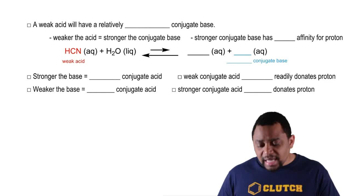
Weak Acids and Conjugate Bases
HF (hydrofluoric acid) is a weak acid that partially dissociates in solution, while NaF (sodium fluoride) provides the conjugate base F-. The presence of both a weak acid and its conjugate base in a solution creates a buffer system, which helps maintain a relatively stable pH when small amounts of acid or base are added.
추천 영상:
가이드 코스
Conjugate Acid-Base Relationships
ICE Table (Initial, Change, Equilibrium)
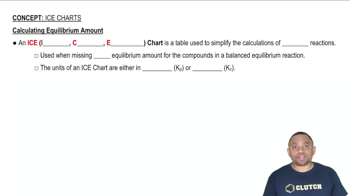
An ICE table is a tool used to organize the initial concentrations, the changes in concentrations as the reaction reaches equilibrium, and the final equilibrium concentrations. For the equilibrium problem involving HF and F-, the ICE table will help calculate the concentrations of H+ ions, which are necessary for determining the pH of the solution.
추천 영상:
가이드 코스
ICE Charts and Equilibrium Amount
Henderson-Hasselbalch Equation
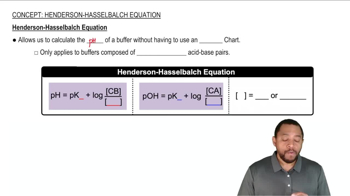
The Henderson-Hasselbalch equation relates the pH of a buffer solution to the concentration of the weak acid and its conjugate base. It is expressed as pH = pKa + log([A-]/[HA]), where pKa is the negative logarithm of the acid dissociation constant. This equation simplifies the calculation of pH in buffer solutions like the one formed by HF and NaF.
추천 영상:
가이드 코스
Henderson-Hasselbalch Equation
관련 실천
교과서 질문
2830
views
교과서 질문
A buffer contains significant amounts of ammonia and ammonium chloride. Write equations showing how this buffer neutralizes added acid and added base.
1687
views
교과서 질문
Use the Henderson–Hasselbalch equation to calculate the pH of each solution in Problem 29.
교과서 질문
Solve an equilibrium problem (using an ICE table) to calculate the pH of each solution. a. 0.15 M HF
1231
views
교과서 질문
Solve an equilibrium problem (using an ICE table) to calculate the pH of each solution. b. 0.15 M NaF
508
views
교과서 질문
Calculate the percent ionization of a 0.20 M benzoic acid solution in pure water and in a solution containing 0.25 M sodium benzoate. Why does the percent ionization differ significantly in the two solutions?