Ch.18 - Aqueous Ionic Equilibrium
Tro - Chemistry: A Molecular Approach 6th Edition
Tro6th EditionChemistry: A Molecular ApproachISBN: 9780137832217당신이 사용하는 게 아니라요?교과서 변경
18장, 문제 33a

Solve an equilibrium problem (using an ICE table) to calculate the pH of each solution. a. 0.15 M HF

검증된 단계별 안내
1
Write the balanced chemical equation for the dissociation of HF in water: \( \text{HF} \rightleftharpoons \text{H}^+ + \text{F}^- \).
Set up the ICE table (Initial, Change, Equilibrium) for the concentrations of HF, H⁺, and F⁻. Initially, [HF] = 0.15 M, [H⁺] = 0, and [F⁻] = 0.
Define the change in concentration for the reaction: let \( x \) be the amount of HF that dissociates. At equilibrium, [HF] = 0.15 - x, [H⁺] = x, and [F⁻] = x.
Write the expression for the acid dissociation constant \( K_a \) for HF: \( K_a = \frac{[\text{H}^+][\text{F}^-]}{[\text{HF}]} \). Substitute the equilibrium concentrations into this expression.
Solve the equation for \( x \) to find the concentration of \( \text{H}^+ \), then calculate the pH using the formula \( \text{pH} = -\log[\text{H}^+] \).

비슷한 문제에 대한 검증된 영상 답변:

이 영상 해법은 위 문제에 도움이 된다고 튜터들이 추천한 것입니다.
영상 길이:
3m
도움이 되었나요?

주요 개념

질문에 올바르게 답하기 위해 반드시 이해해야 하는 핵심 개념들은 다음과 같습니다.

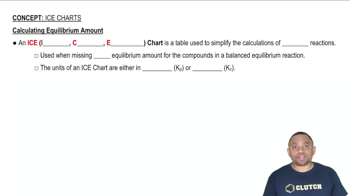
Equilibrium and ICE Tables

Equilibrium in chemistry refers to the state where the concentrations of reactants and products remain constant over time. An ICE table (Initial, Change, Equilibrium) is a tool used to organize the concentrations of species involved in a reaction at different stages. It helps in calculating the changes in concentration as the system reaches equilibrium, which is essential for solving equilibrium problems.
추천 영상:
가이드 코스
01:14
ICE Charts and Equilibrium Amount

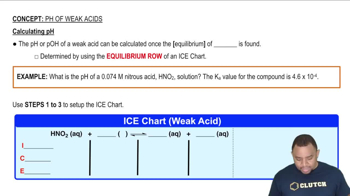
Weak Acids and pH Calculation

Weak acids, like hydrofluoric acid (HF), do not completely dissociate in solution, leading to an equilibrium between the undissociated acid and its ions. The pH of a weak acid solution can be calculated using the acid dissociation constant (Ka) and the initial concentration of the acid. The formula pH = -log[H⁺] is used, where [H⁺] can be derived from the equilibrium concentrations established in the ICE table.
추천 영상:
가이드 코스
07:51
Calculating pH of Weak Acids Example

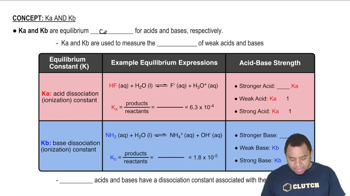
Acid Dissociation Constant (Ka)

The acid dissociation constant (Ka) quantifies the strength of a weak acid in solution, representing the equilibrium constant for its dissociation into ions. A higher Ka value indicates a stronger weak acid, while a lower Ka suggests a weaker acid. For HF, knowing its Ka value allows for the calculation of the concentration of hydrogen ions at equilibrium, which is crucial for determining the pH of the solution.
추천 영상:
가이드 코스
03:50
Characteristics of Ka and Kb