Ch.10 - Chemical Bonding I: The Lewis Model
Tro - Chemistry: A Molecular Approach 6th Edition
Tro6th EditionChemistry: A Molecular ApproachISBN: 9780137832217당신이 사용하는 게 아니라요?교과서 변경
10장, 문제 50

Use the Born–Haber cycle and data from Appendix IIB and Table 10.3 to calculate the lattice energy of MgO. (ΔHsub for magnesium is 137 kJ/mol; IE1 and IE2 for magnesium are 738 kJ/mol and 1450 kJ/mol, respectively; EA1 and EA2 for O are −141 kJ/mol and 744 kJ/mol, respectively.)

검증된 단계별 안내
1
Identify the steps involved in the Born–Haber cycle for the formation of MgO from its elements in their standard states.
Write the equation for the sublimation of solid magnesium to gaseous magnesium: \( \text{Mg(s)} \rightarrow \text{Mg(g)} \) with \( \Delta H_{\text{sub}} = 137 \text{ kJ/mol} \).
Write the equations for the ionization of gaseous magnesium: \( \text{Mg(g)} \rightarrow \text{Mg}^+(g) + e^- \) with \( \text{IE}_1 = 738 \text{ kJ/mol} \) and \( \text{Mg}^+(g) \rightarrow \text{Mg}^{2+}(g) + e^- \) with \( \text{IE}_2 = 1450 \text{ kJ/mol} \).
Write the equations for the electron affinity of oxygen: \( \text{O(g)} + e^- \rightarrow \text{O}^-(g) \) with \( \text{EA}_1 = -141 \text{ kJ/mol} \) and \( \text{O}^-(g) + e^- \rightarrow \text{O}^{2-}(g) \) with \( \text{EA}_2 = 744 \text{ kJ/mol} \).
Use Hess's law to combine these steps with the formation of MgO from its ions to solve for the lattice energy: \( \text{Mg}^{2+}(g) + \text{O}^{2-}(g) \rightarrow \text{MgO(s)} \).

비슷한 문제에 대한 검증된 영상 답변:

이 영상 해법은 위 문제에 도움이 된다고 튜터들이 추천한 것입니다.
도움이 되었나요?

주요 개념

질문에 올바르게 답하기 위해 반드시 이해해야 하는 핵심 개념들은 다음과 같습니다.

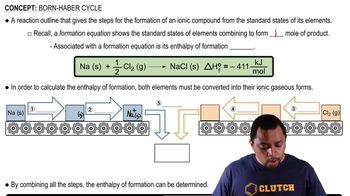
Born-Haber Cycle

The Born-Haber cycle is a thermodynamic cycle that relates the lattice energy of an ionic compound to its formation enthalpy and the energies involved in the formation of its constituent ions. It involves several steps, including the sublimation of the metal, ionization energy, electron affinity, and the formation of the ionic lattice. This cycle allows for the calculation of lattice energy indirectly by using known enthalpy changes.
추천 영상:
가이드 코스
03:49
Born Haber Cycle

Lattice Energy

Lattice energy is the energy released when gaseous ions combine to form an ionic solid, or conversely, the energy required to separate one mole of an ionic solid into its gaseous ions. It is a measure of the strength of the forces between the ions in an ionic compound. Higher lattice energy indicates stronger ionic bonds, which typically results in higher melting and boiling points for the compound.
추천 영상:

Ionization Energy and Electron Affinity

Ionization energy (IE) is the energy required to remove an electron from a neutral atom in the gas phase, while electron affinity (EA) is the energy change that occurs when an electron is added to a neutral atom. In the context of the Born-Haber cycle, these energies are crucial for determining the energy changes associated with forming cations and anions from their respective atoms, which are essential steps in calculating lattice energy.
추천 영상:
가이드 코스
01:34
Electron Affinity