The lattice energy of CsF is -744 kJ/mol, whereas that of BaO is -3029 kJ/mol. Explain this large difference in lattice energy.
Ch.10 - Chemical Bonding I: The Lewis Model

10장, 문제 49
Use the Born–Haber cycle and data from Appendix IIB, Chapter 9 and this chapter to calculate the lattice energy of LiBr. (ΔHsub for lithium is 138 kJ>mol.)
검증된 단계별 안내1
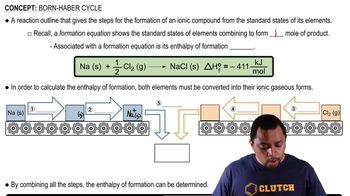
Identify the steps involved in the Born–Haber cycle for LiBr, which include sublimation of lithium, ionization of lithium, dissociation of bromine, electron affinity of bromine, and formation of LiBr from gaseous ions.
Write the equation for the sublimation of lithium: \( \text{Li(s)} \rightarrow \text{Li(g)} \) with \( \Delta H_{\text{sub}} = 138 \text{ kJ/mol} \).
Write the equation for the ionization of gaseous lithium: \( \text{Li(g)} \rightarrow \text{Li}^+(g) + e^- \) and use the ionization energy from the appendix.
Write the equation for the dissociation of bromine: \( \frac{1}{2} \text{Br}_2(g) \rightarrow \text{Br}(g) \) and use the bond dissociation energy from the appendix.
Write the equation for the formation of LiBr from gaseous ions: \( \text{Li}^+(g) + \text{Br}^-(g) \rightarrow \text{LiBr(s)} \) and solve for the lattice energy using Hess's law by summing all the enthalpy changes.

비슷한 문제에 대한 검증된 영상 답변:
이 영상 해법은 위 문제에 도움이 된다고 튜터들이 추천한 것입니다.
영상 길이:
3m도움이 되었나요?
주요 개념
질문에 올바르게 답하기 위해 반드시 이해해야 하는 핵심 개념들은 다음과 같습니다.
Born-Haber Cycle
The Born-Haber cycle is a thermodynamic cycle that relates the lattice energy of an ionic compound to its formation enthalpy and the energies involved in the formation of gaseous ions. It combines several steps, including sublimation, ionization, and electron affinity, to calculate the lattice energy indirectly. This cycle is essential for understanding how ionic compounds form and the energy changes associated with these processes.
추천 영상:
가이드 코스
Born Haber Cycle
Lattice Energy
Lattice energy is the energy released when gaseous ions combine to form an ionic solid, or conversely, the energy required to separate one mole of an ionic solid into its gaseous ions. It is a measure of the strength of the ionic bonds in the solid and is influenced by the charges of the ions and the distance between them. Higher lattice energy indicates stronger ionic interactions and greater stability of the ionic compound.
추천 영상:
가이드 코스
Lattice Energy
Enthalpy Changes
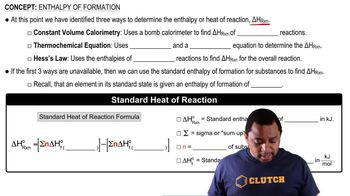
Enthalpy changes refer to the heat content changes during chemical reactions or phase changes at constant pressure. In the context of the Born-Haber cycle, various enthalpy changes such as sublimation, ionization, and electron affinity are used to calculate the overall enthalpy change for the formation of an ionic compound. Understanding these enthalpy changes is crucial for accurately determining the lattice energy and predicting the stability of ionic compounds.
추천 영상:
가이드 코스
Enthalpy of Formation
관련 실천
교과서 질문
2194
views
교과서 질문
Write the Lewis structure for each molecule. a. PH3 b. SCl2 c. HI
905
views
교과서 질문
Arrange these compounds in order of increasing magnitude of lattice energy: CaO, NaBr, CsI, BaS.
4
views
교과서 질문
Rubidium iodide has a lattice energy of -617 kJ/mol, while potassium bromide has a lattice energy of -671 kJ/mol. Why is the lattice energy of potassium bromide more exothermic than the lattice energy of rubidium iodide?
1490
views
교과서 질문
Use the Born–Haber cycle and data from Appendix IIB and Table 10.3 to calculate the lattice energy of MgO. (ΔHsub for magnesium is 137 kJ/mol; IE1 and IE2 for magnesium are 738 kJ/mol and 1450 kJ/mol, respectively; EA1 and EA2 for O are −141 kJ/mol and 744 kJ/mol, respectively.)