The tabulated data were collected for this reaction at 500 °C: CH3CN(g) → CH3NC( g) a. Determine the order of the reaction and the value of the rate constant at this temperature.
Ch.15 - Chemical Kinetics

15장, 문제 90a
The tabulated data were collected for this reaction at a certain temperature: X2Y → 2 X + Y a. Determine the order of the reaction and the value of the rate constant at this temperature.
검증된 단계별 안내1
Identify the general form of the rate law for the reaction, which can be expressed as Rate = k[X2Y]n, where k is the rate constant, [X2Y] is the concentration of the reactant, and n is the order of the reaction with respect to X2Y.
Plot the provided concentration data of X2Y against time on a graph to visually inspect how the concentration changes. This can help in determining the reaction order by looking at the shape of the curve.
To determine the order of the reaction (n), try fitting the data to different kinetic models: zero-order (plot [X2Y] vs. time), first-order (plot ln([X2Y]) vs. time), and second-order (plot 1/[X2Y] vs. time). The plot that results in a straight line indicates the order of the reaction.
Once the order of the reaction is determined from the best-fit line, use the slope of this line to calculate the rate constant (k). The relationship between the slope and k depends on the order of the reaction: for zero-order, slope = -k; for first-order, slope = -k; for second-order, slope = k.
Compile the results to summarize the order of the reaction and the value of the rate constant (k) at the given temperature.

비슷한 문제에 대한 검증된 영상 답변:
이 영상 해법은 위 문제에 도움이 된다고 튜터들이 추천한 것입니다.
영상 길이:
2m도움이 되었나요?
주요 개념
질문에 올바르게 답하기 위해 반드시 이해해야 하는 핵심 개념들은 다음과 같습니다.
Reaction Order
The order of a reaction refers to the power to which the concentration of a reactant is raised in the rate law. It indicates how the rate of reaction depends on the concentration of reactants. For example, a first-order reaction depends linearly on the concentration of one reactant, while a second-order reaction depends on the square of the concentration. Understanding the reaction order is crucial for determining how changes in concentration affect the reaction rate.
추천 영상:
가이드 코스
Average Bond Order
Rate Law
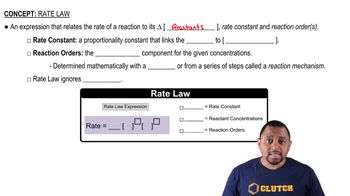
The rate law is an equation that relates the rate of a chemical reaction to the concentration of its reactants. It is typically expressed in the form Rate = k[A]^m[B]^n, where k is the rate constant, and m and n are the orders of the reaction with respect to reactants A and B, respectively. The rate law is determined experimentally and is essential for calculating the rate constant and understanding the kinetics of the reaction.
추천 영상:
가이드 코스
Rate Law Fundamentals
Rate Constant (k)
The rate constant, denoted as k, is a proportionality factor in the rate law that is specific to a particular reaction at a given temperature. It reflects the speed of the reaction; a larger k indicates a faster reaction. The value of k can be determined from experimental data and is influenced by factors such as temperature and the presence of catalysts. Understanding k is vital for predicting how quickly a reaction will proceed under specific conditions.
추천 영상:
가이드 코스
Equilibrium Constant K
관련 실천
교과서 질문
1711
views
교과서 질문
The tabulated data were collected for this reaction at a certain temperature: X2Y → 2 X + Y c. What is the concentration of X after 10.0 hours?
1122
views
교과서 질문
Consider the reaction: 2 O3(g) → 3 O2( g) The rate law for this reaction is: Rate = k [O3]2 [O2] Suppose that a 1.0-L reaction vessel initially contains 1.0 mol of O3 and 1.0 mol of O2. What fraction of the O3 will have reacted when the rate falls to one-half of its initial value?
2049
views
교과서 질문
The tabulated data were collected for this reaction at 500 °C: CH3CN(g) → CH3NC( g) b. What is the half-life for this reaction (at the initial concentration)?
477
views