Ch.17 - Acids and Bases
Tro - Chemistry: A Molecular Approach 6th Edition
Tro6th EditionChemistry: A Molecular ApproachISBN: 9780137832217당신이 사용하는 게 아니라요?교과서 변경
17장, 문제 35c

Write the formula for the conjugate acid of each base. c. HCO3–

검증된 단계별 안내
1
Identify the base in the problem: \( \text{HCO}_3^- \).
Recall that a conjugate acid is formed by adding a proton (\( \text{H}^+ \)) to the base.
Add a proton to the base \( \text{HCO}_3^- \) to form the conjugate acid.
The addition of \( \text{H}^+ \) to \( \text{HCO}_3^- \) results in \( \text{H}_2\text{CO}_3 \).
Write the formula for the conjugate acid: \( \text{H}_2\text{CO}_3 \).

비슷한 문제에 대한 검증된 영상 답변:

이 영상 해법은 위 문제에 도움이 된다고 튜터들이 추천한 것입니다.
영상 길이:
32s
도움이 되었나요?

주요 개념

질문에 올바르게 답하기 위해 반드시 이해해야 하는 핵심 개념들은 다음과 같습니다.

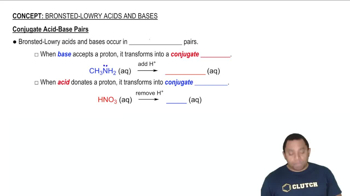
Conjugate Acid-Base Pair

In acid-base chemistry, a conjugate acid is formed when a base accepts a proton (H+). This relationship is part of the Brønsted-Lowry theory, which defines acids as proton donors and bases as proton acceptors. Each acid-base pair differs by one proton, illustrating the dynamic nature of proton transfer in chemical reactions.
추천 영상:
가이드 코스
01:30
Conjugate Acid-Base Pairs

Bicarbonate Ion (HCO3–)

The bicarbonate ion (HCO3–) is an important buffer in biological systems and plays a crucial role in maintaining pH balance. It can act as a base by accepting a proton to form carbonic acid (H2CO3), which is essential in processes like respiration and metabolic regulation. Understanding its behavior is key to identifying its conjugate acid.
추천 영상:

Protonation

Protonation is the process by which a molecule gains a proton (H+), resulting in the formation of a conjugate acid. This process is fundamental in acid-base reactions, as it alters the charge and reactivity of the molecule. For the bicarbonate ion, protonation leads to the formation of carbonic acid, illustrating how bases can transform into acids through protonation.
추천 영상:
가이드 코스
01:38
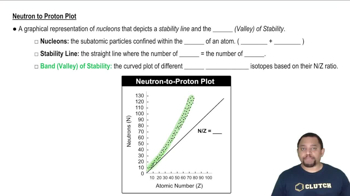
Neutron-to-Proton Plot