A 100.0-mL buffer solution is 0.100 M in NH3 and 0.125 M in NH4Br. What mass of HCl can this buffer neutralize before the pH falls below 9.00?
Ch.18 - Aqueous Ionic Equilibrium

18장, 문제 54d
Determine whether or not the mixing of each pair of solutions results in a buffer. d. 105.0 mL of 0.12 M CH3NH2 ; 110.0 mL of 0.15 M CH3NH3Cl
검증된 단계별 안내1
Identify the components of the solutions: CH3NH2 is a weak base and CH3NH3Cl is its conjugate acid.
Calculate the moles of CH3NH2: Use the formula \( \text{moles} = \text{volume (L)} \times \text{molarity (M)} \).
Calculate the moles of CH3NH3Cl: Use the same formula \( \text{moles} = \text{volume (L)} \times \text{molarity (M)} \).
Determine if the solution can act as a buffer: A buffer solution contains a weak acid and its conjugate base or a weak base and its conjugate acid in comparable amounts.
Compare the moles of CH3NH2 and CH3NH3Cl to see if they are present in significant amounts to resist changes in pH.

비슷한 문제에 대한 검증된 영상 답변:
이 영상 해법은 위 문제에 도움이 된다고 튜터들이 추천한 것입니다.
영상 길이:
6m도움이 되었나요?
주요 개념
질문에 올바르게 답하기 위해 반드시 이해해야 하는 핵심 개념들은 다음과 같습니다.
Buffer Solutions
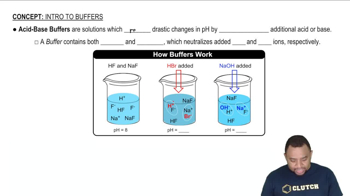
A buffer solution is a system that resists changes in pH upon the addition of small amounts of acid or base. It typically consists of a weak acid and its conjugate base or a weak base and its conjugate acid. In this case, the presence of CH3NH2 (a weak base) and CH3NH3Cl (its conjugate acid) suggests that the mixture could function as a buffer.
추천 영상:
가이드 코스
Buffer Solutions
Weak Bases and Conjugate Acids
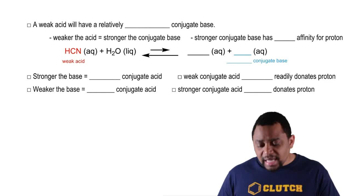
Weak bases are substances that partially ionize in solution, establishing an equilibrium between the base and its conjugate acid. CH3NH2 is a weak base, and when mixed with CH3NH3Cl, it can establish an equilibrium that allows the solution to maintain a relatively stable pH, characteristic of buffer systems.
추천 영상:
가이드 코스
Conjugate Acid-Base Relationships
Henderson-Hasselbalch Equation
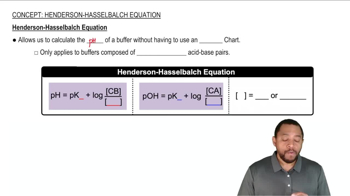
The Henderson-Hasselbalch equation is used to calculate the pH of a buffer solution. It relates the pH to the pKa of the weak acid and the ratio of the concentrations of the conjugate base and acid. This equation is essential for determining the effectiveness of the buffer formed by the mixing of CH3NH2 and CH3NH3Cl.
추천 영상:
가이드 코스
Henderson-Hasselbalch Equation
관련 실천
교과서 질문
1290
views
1
comments
교과서 질문
For each solution, calculate the initial and final pH after adding 0.010 mol of NaOH. a. 250.0 mL of pure water b. 250.0 mL of a buffer solution that is 0.195 M in HCHO2 and 0.275 M in KCHO2 c. 250.0 mL of a buffer solution that is 0.255 M in CH3CH2NH2 and 0.235 M in CH3CH2NH3Cl
1490
views
교과서 질문
Determine whether or not the mixing of each pair of solutions results in a buffer. a. 155.0 mL of 0.15 M NH3 ; 175.0 mL of 0.17 M HCl
교과서 질문
Determine whether or not the mixing of each pair of solutions results in a buffer. c. 55.0 mL of 0.15 M HF; 85.0 mL of 0.10 M NaF
교과서 질문
Determine whether or not the mixing of each pair of solutions results in a buffer. b. 125.0 mL of 0.14 M HF; 195.0 mL of 0.070 M NaOH