Determine whether or not the mixing of each pair of solutions results in a buffer. b.155.0 mL of 0.15 M NH3 ; 155.0 mL of 0.10 M HCl

Ch.18 - Aqueous Ionic Equilibrium

18장, 문제 56a
Determine whether or not the mixing of each pair of solutions results in a buffer. a. 155.0 mL of 0.15 M NH3 ; 175.0 mL of 0.17 M HCl
검증된 단계별 안내1
Identify the components needed for a buffer solution: a weak base and its conjugate acid, or a weak acid and its conjugate base.
Recognize that NH3 (ammonia) is a weak base and HCl (hydrochloric acid) is a strong acid.
Calculate the moles of NH3 using the formula: moles = concentration (M) × volume (L).
Calculate the moles of HCl using the formula: moles = concentration (M) × volume (L).
Determine if the reaction between NH3 and HCl will result in a buffer by checking if there is an excess of NH3 after the reaction, which would leave a mixture of NH3 and NH4+ (the conjugate acid).

비슷한 문제에 대한 검증된 영상 답변:
이 영상 해법은 위 문제에 도움이 된다고 튜터들이 추천한 것입니다.
영상 길이:
6m도움이 되었나요?
주요 개념
질문에 올바르게 답하기 위해 반드시 이해해야 하는 핵심 개념들은 다음과 같습니다.
Buffer Solutions
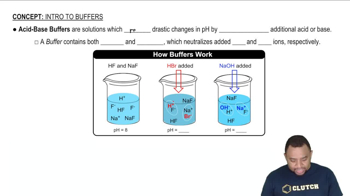
A buffer solution is a system that resists changes in pH upon the addition of small amounts of acid or base. It typically consists of a weak acid and its conjugate base or a weak base and its conjugate acid. Buffers maintain pH stability, which is crucial in many chemical and biological processes.
추천 영상:
가이드 코스
Buffer Solutions
Weak Bases and Strong Acids
In the given question, NH3 (ammonia) is a weak base, while HCl (hydrochloric acid) is a strong acid. When mixed, the weak base can partially neutralize the strong acid, but the resulting solution may not form a buffer unless there is a sufficient amount of the weak base to react with the strong acid.
추천 영상:
가이드 코스
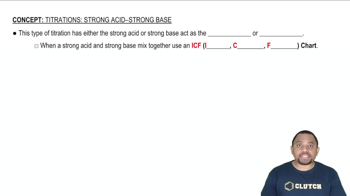
Strong Acid-Strong Base Titration
Stoichiometry of Acid-Base Reactions
Stoichiometry involves the calculation of reactants and products in chemical reactions. In this context, it is essential to determine the moles of NH3 and HCl to assess whether they can react completely or if excess amounts of either component will remain, influencing the ability to form a buffer solution.
추천 영상:
가이드 코스
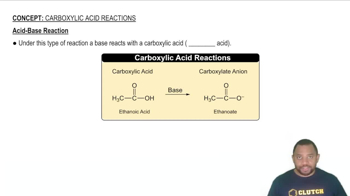
Acid-Base Reaction
관련 실천
교과서 질문
교과서 질문
Determine whether or not the mixing of each pair of solutions results in a buffer. d. 105.0 mL of 0.12 M CH3NH2 ; 110.0 mL of 0.15 M CH3NH3Cl
교과서 질문
Determine whether or not the mixing of each pair of solutions results in a buffer. d. 150.0 mL of 0.15 M HCl; 135.0 mL of 0.25 M NaOH
교과서 질문
Determine whether or not the mixing of each pair of solutions results in a buffer. c. 225.0 mL of 0.10 M NH3 ; 250.0 mL of 0.15 M NH4Cl
교과서 질문
Determine whether or not the mixing of each pair of solutions results in a buffer. c. 55.0 mL of 0.15 M HF; 85.0 mL of 0.10 M NaF
교과서 질문
Determine whether or not the mixing of each pair of solutions results in a buffer. b. 125.0 mL of 0.14 M HF; 195.0 mL of 0.070 M NaOH