Calculate the empirical formula for each natural flavor based on its elemental mass percent composition. a. methyl butyrate (component of apple taste and smell): C 58.80%, H 9.87%, O 31.33%
Ch.3 - Molecules and Compounds

3장, 문제 96b
A chemist decomposes samples of several compounds; the masses of their constituent elements are listed. Calculate the empirical formula for each compound. b. 2.677 g Ba, 3.115 g Br
검증된 단계별 안내1
Determine the moles of each element by dividing the given mass by the atomic mass of the element. For barium (Ba), use its atomic mass of approximately 137.33 g/mol. For bromine (Br), use its atomic mass of approximately 79.90 g/mol.
Calculate the moles of Ba: \( \text{moles of Ba} = \frac{2.677 \text{ g}}{137.33 \text{ g/mol}} \).
Calculate the moles of Br: \( \text{moles of Br} = \frac{3.115 \text{ g}}{79.90 \text{ g/mol}} \).
Determine the simplest whole number ratio of moles of Ba to moles of Br by dividing each by the smallest number of moles calculated.
Write the empirical formula using the whole number ratio obtained from the previous step, with Ba and Br as the elements in the formula.

비슷한 문제에 대한 검증된 영상 답변:
이 영상 해법은 위 문제에 도움이 된다고 튜터들이 추천한 것입니다.
영상 길이:
2m도움이 되었나요?
주요 개념
질문에 올바르게 답하기 위해 반드시 이해해야 하는 핵심 개념들은 다음과 같습니다.
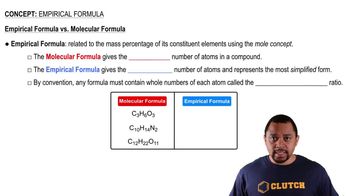
Empirical Formula
The empirical formula of a compound represents the simplest whole-number ratio of the elements present in that compound. It is derived from the mass of each element in a sample, which is converted to moles, allowing for the determination of the ratio of the elements. This formula does not provide information about the actual number of atoms in a molecule but rather the relative proportions of each element.
추천 영상:
가이드 코스
Empirical vs Molecular Formula
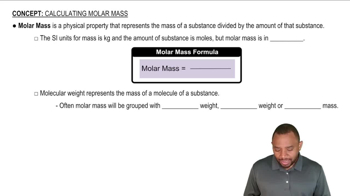
Molar Mass
Molar mass is the mass of one mole of a substance, typically expressed in grams per mole (g/mol). It is calculated by summing the atomic masses of all the atoms in a compound's molecular formula. Understanding molar mass is essential for converting between grams and moles, which is a critical step in determining the empirical formula from mass data.
추천 영상:
가이드 코스
Molar Mass Concept
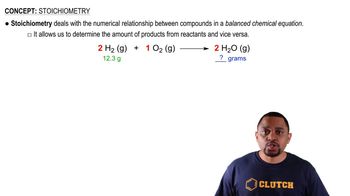
Stoichiometry
Stoichiometry is the area of chemistry that deals with the relationships between the quantities of reactants and products in chemical reactions. It involves using balanced chemical equations to calculate the amounts of substances consumed and produced. In the context of finding empirical formulas, stoichiometry helps in determining the mole ratios of the elements based on their masses.
추천 영상:
가이드 코스
Stoichiometry Concept
관련 실천
교과서 질문
1232
views
교과서 질문
Calculate the empirical formula for each stimulant based on its elemental mass percent composition.
a. nicotine (found in tobacco leaves): C 74.03%, H 8.70%, N 17.27%
b. caffeine (found in coffee beans): C 49.48%, H 5.19%, N 28.85%, O 16.48%
1476
views
교과서 질문
How many bromine atoms are present in 12.8 g of CH2Br2?
교과서 질문
A chemist decomposes samples of several compounds; the masses of their constituent elements are listed. Calculate the empirical formula for each compound. c. 2.128 g Be, 7.557 g S, 15.107 g O
2129
views
2
rank
교과서 질문
How many fluorine atoms are present in 45.3 g of C2F4?
교과서 질문
A chemist decomposes samples of several compounds; the masses of their constituent elements are listed. Calculate the empirical formula for each compound. a. 1.245 g Ni, 5.381 g I
691
views