
Ch.3 - Molecules and Compounds
Tro - Chemistry: A Molecular Approach 6th Edition
Tro6th EditionChemistry: A Molecular ApproachISBN: 9780137832217당신이 사용하는 게 아니라요?교과서 변경
3장, 문제 96a

A chemist decomposes samples of several compounds; the masses of their constituent elements are listed. Calculate the empirical formula for each compound. a. 1.245 g Ni, 5.381 g I

검증된 단계별 안내
1
Determine the number of moles of each element by dividing the mass of each element by its molar mass. For Nickel (Ni), use its molar mass of approximately 58.69 g/mol, and for Iodine (I), use its molar mass of approximately 126.90 g/mol.
Calculate the moles of Nickel (Ni) using the formula: \( \text{moles of Ni} = \frac{1.245 \text{ g}}{58.69 \text{ g/mol}} \).
Calculate the moles of Iodine (I) using the formula: \( \text{moles of I} = \frac{5.381 \text{ g}}{126.90 \text{ g/mol}} \).
Determine the simplest whole number ratio of moles of Ni to moles of I by dividing each by the smallest number of moles calculated in the previous steps.
Write the empirical formula by using the whole number ratio as subscripts for each element in the compound.

비슷한 문제에 대한 검증된 영상 답변:

이 영상 해법은 위 문제에 도움이 된다고 튜터들이 추천한 것입니다.
영상 길이:
2m
도움이 되었나요?

주요 개념

질문에 올바르게 답하기 위해 반드시 이해해야 하는 핵심 개념들은 다음과 같습니다.

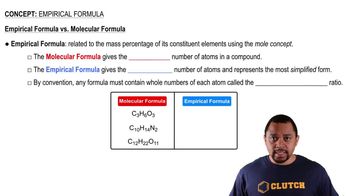
Empirical Formula

The empirical formula of a compound represents the simplest whole-number ratio of the elements present in that compound. It is derived from the mass of each element and is crucial for understanding the composition of the compound. For example, if a compound contains 1 mole of element A and 2 moles of element B, its empirical formula would be AB2.
추천 영상:
가이드 코스
02:26
Empirical vs Molecular Formula

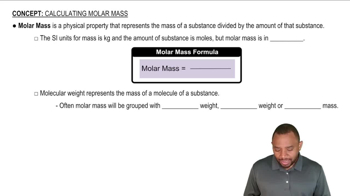
Molar Mass

Molar mass is the mass of one mole of a substance, typically expressed in grams per mole (g/mol). It is essential for converting the mass of each element in a sample to moles, which allows for the determination of the ratio of elements in the empirical formula. For instance, the molar mass of nickel (Ni) is approximately 58.69 g/mol, and for iodine (I), it is about 126.90 g/mol.
추천 영상:
가이드 코스
02:11
Molar Mass Concept

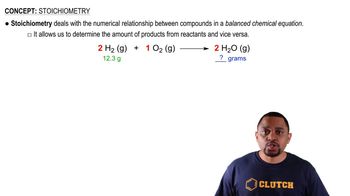
Stoichiometry

Stoichiometry is the branch of chemistry that deals with the quantitative relationships between the reactants and products in a chemical reaction. It involves using balanced chemical equations to calculate the amounts of substances involved. In the context of finding an empirical formula, stoichiometry helps in determining the mole ratios of the elements based on their masses.
추천 영상:
가이드 코스
01:16
Stoichiometry Concept