Ch.4 - Chemical Reactions and Chemical Quantities
Tro - Chemistry: A Molecular Approach 6th Edition
Tro6th EditionChemistry: A Molecular ApproachISBN: 9780137832217당신이 사용하는 게 아니라요?교과서 변경
4장, 문제 34c

Balance the equation and calculate how many moles of N2 form when each quantity of reactant completely reacts. N2H4(l) → NH3(g) + N2(g) c. 33.9 g N2H4

검증된 단계별 안내
1
Step 1: Write the unbalanced chemical equation: \( \text{N}_2\text{H}_4(l) \rightarrow \text{NH}_3(g) + \text{N}_2(g) \).
Step 2: Balance the chemical equation. Start by balancing the nitrogen atoms. Since there are 2 nitrogen atoms in \( \text{N}_2\text{H}_4 \), you need 2 \( \text{NH}_3 \) molecules to balance the nitrogen: \( \text{N}_2\text{H}_4(l) \rightarrow 2\text{NH}_3(g) + \text{N}_2(g) \).
Step 3: Check the balance of hydrogen atoms. \( \text{N}_2\text{H}_4 \) has 4 hydrogen atoms, and 2 \( \text{NH}_3 \) molecules have 6 hydrogen atoms. Adjust the equation to balance hydrogen: \( 3\text{N}_2\text{H}_4(l) \rightarrow 4\text{NH}_3(g) + 3\text{N}_2(g) \).
Step 4: Calculate the molar mass of \( \text{N}_2\text{H}_4 \) using the atomic masses: \( 2 \times 14.01 + 4 \times 1.01 = 32.05 \text{ g/mol} \).
Step 5: Convert 33.9 g of \( \text{N}_2\text{H}_4 \) to moles using its molar mass: \( \text{moles of } \text{N}_2\text{H}_4 = \frac{33.9 \text{ g}}{32.05 \text{ g/mol}} \). Use the balanced equation to find moles of \( \text{N}_2 \) produced: \( \text{moles of } \text{N}_2 = \frac{3}{3} \times \text{moles of } \text{N}_2\text{H}_4 \).

비슷한 문제에 대한 검증된 영상 답변:

이 영상 해법은 위 문제에 도움이 된다고 튜터들이 추천한 것입니다.
영상 길이:
2m

주요 개념

질문에 올바르게 답하기 위해 반드시 이해해야 하는 핵심 개념들은 다음과 같습니다.

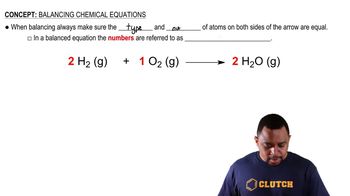
Balancing Chemical Equations

Balancing chemical equations involves ensuring that the number of atoms of each element is the same on both sides of the equation. This is crucial for obeying the law of conservation of mass, which states that matter cannot be created or destroyed in a chemical reaction. In the given reaction, balancing will help determine the stoichiometric relationships between the reactants and products.
추천 영상:
가이드 코스
01:32
Balancing Chemical Equations

Stoichiometry

Stoichiometry is the calculation of reactants and products in chemical reactions based on balanced equations. It allows chemists to predict how much of a product will form from a given amount of reactant. In this case, stoichiometry will be used to calculate the moles of N2 produced from the given mass of N2H4, using the molar ratios derived from the balanced equation.
추천 영상:
가이드 코스
01:16
Stoichiometry Concept

Molar Mass

Molar mass is the mass of one mole of a substance, typically expressed in grams per mole (g/mol). It is essential for converting between grams and moles in stoichiometric calculations. For N2H4, the molar mass must be calculated to convert the given mass (33.9 g) into moles, which will then be used to find the amount of N2 produced in the reaction.
추천 영상:
가이드 코스
02:11
Molar Mass Concept
관련 실천
교과서 질문

Balance each chemical equation. b. Co(NO3)3(aq) + (NH4)2S(aq) → Co2S3(s) + NH4NO3(aq)

1403
views

교과서 질문

Consider the balanced equation:

SiO2(s) + 3 C(s) → SiC(s) + 2 CO(g)

Complete the table showing the appropriate number of moles of reactants and products. If the number of moles of a reactant is provided, fill in the required amount of the other reactant, as well as the moles of each product that forms. If the number of moles of a product is provided, fill in the required amount of each reactant to make that amount of product, as well as the amount of the other product that forms.

1014
views
1
rank
교과서 질문

Balance the equation and calculate how many moles of O2 form when each quantity of reactant completely reacts. N2O5( g) → NO2(g) + O2(g) a. 1.2 mol N2O5

교과서 질문

Hydrobromic acid dissolves solid iron according to the reaction:

Fe(s) + 2 HBr(aq) → FeBr2(aq) + H2(g)

What mass of HBr (in g) do you need to dissolve a 2.80-g pure iron bar on a padlock? What mass of H2 would the complete reaction of the iron bar produce?

교과서 질문

Consider the balanced equation:

SiO2(s) + 3 C(s) → SiC(s) + 2 CO(g)

Complete the table showing the appropriate number of moles of reactants and products. If the number of moles of a reactant is provided, fill in the required amount of the other reactant, as well as the moles of each product that forms. If the number of moles of a product is provided, fill in the required amount of each reactant to make that amount of product, as well as the amount of the other product that forms.

1100
views
교과서 질문

Consider the unbalanced equation for the neutralization of acetic acid: HC2H3O2(aq) + Ba(OH)2(aq) → H2O(l) + Ba(C2H3O2)2(aq) Balance the equation and determine how many moles of Ba(OH)2 are required to completely neutralize 1.22 mol of HC2H3O2.

2
views