Ch.9 - Periodic Properties of the Elements
Tro - Chemistry: A Molecular Approach 6th Edition
Tro6th EditionChemistry: A Molecular ApproachISBN: 9780137832217당신이 사용하는 게 아니라요?교과서 변경
9장, 문제 81

For each element, predict where the "jump" occurs for successive ionization energies. (For example, does the jump occur between the first and second ionization energies, the second and third, the third and fourth, and so on?) a. B b. Na C. P d. S

검증된 단계별 안내
1
Identify the electron configuration of each element to understand the distribution of electrons in their atomic orbitals.
Determine the number of valence electrons for each element, as the 'jump' in ionization energy typically occurs after all valence electrons have been removed.
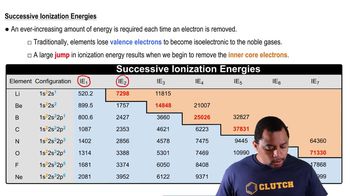
For Boron (B), with an electron configuration of 1s^2 2s^2 2p^1, the jump occurs after the third ionization energy, as the first three electrons are valence electrons.
For Sodium (Na), with an electron configuration of 1s^2 2s^2 2p^6 3s^1, the jump occurs after the first ionization energy, as the first electron is the only valence electron.
For Phosphorus (P) and Sulfur (S), analyze their electron configurations (P: 1s^2 2s^2 2p^6 3s^2 3p^3, S: 1s^2 2s^2 2p^6 3s^2 3p^4) to determine the number of valence electrons and predict where the jump occurs after these electrons are removed.

비슷한 문제에 대한 검증된 영상 답변:

이 영상 해법은 위 문제에 도움이 된다고 튜터들이 추천한 것입니다.
영상 길이:
1m

주요 개념

질문에 올바르게 답하기 위해 반드시 이해해야 하는 핵심 개념들은 다음과 같습니다.

Ionization Energy

Ionization energy is the energy required to remove an electron from a gaseous atom or ion. It is a key concept in understanding how easily an atom can lose electrons, which is crucial for predicting chemical reactivity and the formation of ions. Generally, ionization energy increases across a period and decreases down a group in the periodic table.
추천 영상:
가이드 코스
01:19
Ionization Energy

Successive Ionization Energies

Successive ionization energies refer to the energies required to remove additional electrons from an atom after the first has been removed. Each subsequent ionization energy is typically higher than the previous one due to increased positive charge in the nucleus, which holds the remaining electrons more tightly. However, a significant jump in ionization energy indicates the removal of an electron from a more stable electron configuration, such as a noble gas configuration.
추천 영상:
가이드 코스
02:22
Successive Ionization Energies

Electron Configuration and Stability

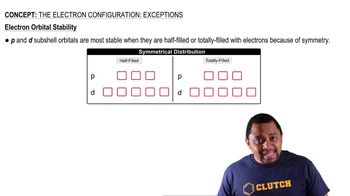
Electron configuration describes the distribution of electrons in an atom's orbitals. Atoms with full or half-full subshells are particularly stable, making the removal of electrons from these configurations more difficult. Understanding the electron configuration of elements like B, Na, P, and S helps predict where jumps in ionization energy occur, as these jumps often happen when an electron is removed from a stable configuration.
추천 영상:
가이드 코스
01:23
Electron Orbital Stability