 뒤로
뒤로Alu Elements: Structure, Mechanism, and Impact on Genome Evolution and Gene Regulation
스터디 가이드 - 스마트 노트
 자료에 맞춘 맞춤형 노트, 핵심 정의, 예시, 맥락을 확장해 제공합니다.
Transposable Elements in the Human Genome
Alu Elements: Overview
Alu elements are a class of short interspersed elements (SINEs) that are primate-specific and constitute approximately 11% of the human genome. With over 1 million copies, they are among the most successful mobile elements. Alu elements are non-autonomous, relying on the LINE-1 (L1) family for their amplification, specifically the ORF2 protein.
Key Point 1: Alu elements contribute to genetic diversity and disease via insertional mutagenesis and non-allelic homologous recombination.
Key Point 2: They influence gene expression through effects on polyadenylation, splicing, and RNA editing.
Example: Alu insertions are implicated in various human diseases, including neurofibromatosis and breast cancer.
Structure and Amplification Mechanism of Alu Elements
Alu Element Structure
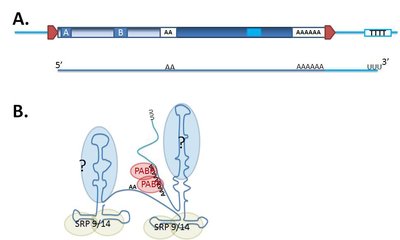
Alu elements are about 280 base pairs long, composed of two diverged dimers derived from the 7SL RNA gene, separated by an A-rich region. The 3' end features a long A-tail, crucial for retrotransposition. Alu elements possess an internal RNA polymerase III promoter but lack a terminator, relying on downstream T-rich sequences for transcription termination.
Key Point 1: Alu elements are flanked by direct repeats formed at the insertion site.
Key Point 2: Each Alu RNA transcript is unique due to mutations, A-tail heterogeneity, and locus-specific 3' ends.
Alu RNA and Ribonucleoprotein Complexes
Alu RNAs fold into distinct structures and bind proteins such as SRP9/14 and polyA-binding protein (PABP), forming ribonucleoprotein particles. These complexes facilitate the association of Alu RNA with ribosomes and the L1 ORF2 protein, enabling retrotransposition.
Key Point 1: SRP9/14 and PABP are essential for Alu RNA function and retrotransposition.
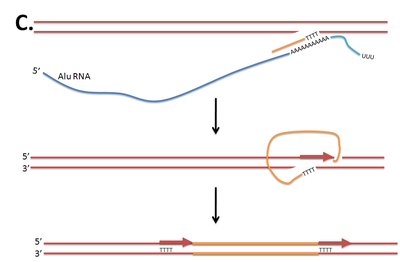
Key Point 2: Alu retrotransposition utilizes target-primed reverse transcription, distinct from L1 mechanisms.
Activity and Evolution of Alu Elements
Factors Influencing Alu Activity
Despite their abundance, only a small fraction of Alu elements are actively amplifying. Activity depends on promoter strength, epigenetic silencing, A-tail length, and sequence divergence. Most Alu elements lose activity over time due to mutations and A-tail shortening.
Key Point 1: Active Alu elements closely match the consensus sequence and have long, intact A-tails.
Key Point 2: Sequence changes, especially in the A-tail and promoter regions, rapidly reduce retrotransposition capability.
Alu Elements and Genome Evolution
Alu elements originated from the 7SL RNA gene and evolved into various subfamilies (J, S, Y) in primates. Their insertion and recombination events have shaped primate genomes, contributing to lineage-specific diversity and genomic instability.
Key Point 1: Alu elements are enriched in gene-rich regions, while L1 elements are found in gene-poor regions.
Key Point 2: Alu-mediated recombination causes deletions, duplications, and inversions, impacting genome structure and disease.
Alu Elements and Human Diversity
Polymorphic Alu Insertions
Alu elements continue to insert in humans, with about one new insert per 20 births. These insertions contribute to genetic diversity and are associated with various diseases, especially when disrupting coding regions or splice signals.
Key Point 1: Alu insertions are a source of structural variation and polymorphism in the human genome.
Key Point 2: Disease-causing insertions are more frequent in certain genes, such as NF1 and BRCA1/2.
Alu Elements in RNA Molecules
Distribution in Transcripts
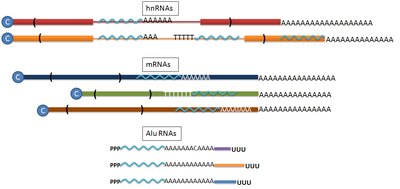
Alu elements are prevalent in introns and 3' non-coding regions of mRNAs, especially in gene-rich areas. Most Alu-containing RNAs are transcribed by RNA polymerase II, not involved in retrotransposition, while authentic Alu RNAs (polymerase III) are rare and difficult to detect.
Key Point 1: Alu sequences are found in both orientations within primary nuclear transcripts (hnRNAs) and mature mRNAs.
Key Point 2: Only a small fraction of Alu RNAs are transcribed by RNA polymerase III and involved in retrotransposition.
Alu Elements and Gene Regulation
Epigenetic and Transcriptional Effects
Alu elements influence gene regulation through methylation, transcription-factor binding, and creation of new CpG islands. Methylation varies by tissue and is reduced in tumors, potentially increasing Alu expression.
Key Point 1: Alu elements host numerous transcription-factor-binding sites, some evolving into regulatory elements.
Key Point 2: Alu methylation may affect nearby gene expression, though causality is not fully established.
Post-Transcriptional Regulation
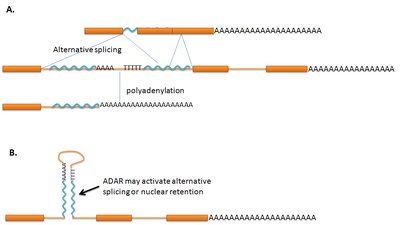
Alu elements contribute to polyadenylation, alternative splicing (exonization), and RNA editing. These processes can alter transcript stability, expression, and function, sometimes leading to disease.
Key Point 1: Alu sequences can mutate to form polyadenylation sites, affecting mRNA processing.
Key Point 2: Alu exonization introduces alternative splicing, often requiring ADAR editing for functionality.
Example: Diseases such as Alport syndrome and Duchenne muscular dystrophy are linked to Alu-mediated splicing defects.
Alu Elements and RNA Editing
ADAR enzymes edit Alu-containing RNAs, converting adenosine to inosine in double-stranded regions formed by Alu elements in opposite orientations. This editing can lead to nuclear retention of transcripts and tissue-specific regulation, especially in the brain.
Key Point 1: ADAR editing is prevalent in primary transcripts with Alu elements, influencing RNA fate.
Key Point 2: Edited Alu RNAs may activate cryptic splice sites or cause nuclear retention.
Alu Elements in Human Disease
Examples of Alu-Related Diseases
Alu insertions and recombination events are implicated in a wide range of genetic disorders, including hemophilia, neurofibromatosis, breast cancer, and others. The table below summarizes some key examples:
Locus | Chromosome | Subfamily | Disease |
|---|---|---|---|
NF1 | 17 | Y subfamilies | Neurofibromatosis |
BRCA1 | 17 | Ya5 | Breast cancer |
BRCA2 | 13 | Ya5, Yc1, Y | Breast cancer |
HEMA (VIII) | X | Yb8, Yb9 | Hemophilia A |
HEMB (IX) | X | Ya5, Yb8 | Hemophilia B |
MSH2 | 2 | Ya5 | Genomic instability |
VHL | 3 | Yb8 | Genomic instability |
CASR | 3 | Ya4 | Hypercalcemia |
APC | 5 | Yb8 | Hereditary desmoid disease |
FGFR2 | 10 | Ya5, Yb8, Yc1 | Apert's syndrome |
LPL | 8 | Yb9 | Lipoprotein lipase deficiency |
POMT1 | 9 | Ya5 | Walker Warburg syndrome |
Conclusion
Alu elements are a major force in primate genome evolution, gene regulation, and human disease. Their high copy number and distribution in gene-rich regions make them central to genetic instability, diversity, and regulatory complexity. Advances in genomics and sequencing technologies are revealing new insights into their roles and impacts.
