 뒤로
뒤로Genetic Ancestry: Concepts, Methods, and Interpretation
스터디 가이드 - 스마트 노트
 자료에 맞춘 맞춤형 노트, 핵심 정의, 예시, 맥락을 확장해 제공합니다.
Genetic Ancestry: Concepts, Methods, and Interpretation
Introduction to Ancestry in Genetics
Ancestry is a fundamental concept in genetics, connecting biological inheritance with cultural, social, and historical identity. The study of ancestry involves both scientific and societal perspectives, and is central to fields such as population genetics, genetic genealogy, and consumer genomics. Understanding ancestry requires distinguishing between several related but distinct concepts: genealogical ancestry, genetic ancestry, and genetic similarity.
Genealogical Ancestry
Genealogical ancestry refers to the individuals from whom a person is biologically descended, as represented in a family tree or pedigree. This concept is intuitive and often quantified by the proportion of ancestors belonging to a particular category (e.g., "one eighth British" if one of eight great-grandparents was British).
Pedigree: A graph structure showing parent-child relationships among ancestors.
Ancestry Categories: Labels (e.g., British, Huguenot) assigned to ancestors based on culture, geography, or other traits.
Quantification: The number of genealogical ancestors increases exponentially with each generation ( ancestors N generations ago).
Limitations: Most people lack comprehensive knowledge of their ancestors beyond a few generations.
Example: If one of your eight great-grandparents belonged to group X, you might describe yourself as "one eighth X".
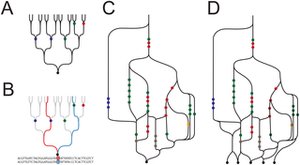
Genetic Ancestry
Genetic ancestry is defined by the subset of genealogical ancestors from whom an individual has inherited genetic material. Due to recombination and the transmission of only half of parental DNA each generation, genetic ancestry represents only a fraction of genealogical ancestry.
Inheritance Paths: At any position in the genome, DNA is inherited through specific paths in the pedigree.
Recombination: Different genome positions may trace different inheritance paths due to meiotic recombination.
Ancestral Recombination Graph (ARG): The fundamental structure representing genetic ancestry, showing the transmission of DNA segments through recombination and coalescence events.
Comparison: Full siblings have identical genealogical ancestry but differ in genetic ancestry due to random assortment of chromosomal segments.
Example: The ARG for an individual shows which parts of the genome were inherited from which ancestors.
Genetic Similarity
Genetic similarity refers to the degree of shared genetic variation between individuals or populations. While often interpreted as ancestry, it is distinct from genealogical and genetic ancestry and is influenced by demographic history, migration, and sampling of reference populations.
Methods: Principal Component Analysis (PCA), ADMIXTURE, Chromopainter, and Li & Stephens models summarize genetic variation and are used to infer ancestry-like relationships.
Reference Populations: The choice and labelling of reference populations affect the interpretation of genetic similarity.
Limitations: Genetic similarity can be informative about broad ancestry but is less reliable for fine-scale or recent ancestry due to population discontinuity and migration.
Example: Segments of your genome similar to individuals from continental groups (e.g., European, African) suggest genetic ancestry from those groups in the past few hundred or thousand years.
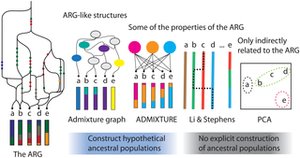
Admixture Graphs and Population Ancestry
Admixture graphs are used to summarize genetic ancestry at the population level, representing populations as nodes and their relationships as edges. These graphs approximate the complex structure of the ARG by averaging ancestry proportions across genomes.
Population Nodes: Represent source populations in the graph.
Admixture Proportions: Individuals are described as having varying proportions of ancestry from multiple source populations.
Drawbacks: Populations may be poorly sampled, unrepresentative, or algorithmic constructs rather than real groups.
Example: An admixture graph may show an individual's ancestry as a mix of European, African, and Native American populations.
Challenges and Caveats in Ancestry Interpretation
All forms of ancestry analysis involve arbitrary choices in category definition, reference population selection, and time period specification. These choices can lead to loss of information and misinterpretation, especially when categories are based on present-day populations rather than historical or ancient groups.
Category Bias: Focusing on known categories may overlook unknown or unsampled ancestry.
Sampling Bias: Under-representation of certain populations in databases can distort ancestry inference.
Identity: Genetic data may inform about ancestors but does not determine group membership or cultural identity.
Summary Table: Key Concepts in Genetic Ancestry
Concept | Definition | Methods | Limitations |
|---|---|---|---|
Genealogical Ancestry | Biological descent from identifiable ancestors | Pedigree analysis, genealogical records | Limited knowledge beyond a few generations |
Genetic Ancestry | Inheritance of DNA segments from subset of ancestors | ARG reconstruction, genetic genealogy | Challenging to infer, incomplete information |
Genetic Similarity | Shared genetic variation between individuals/populations | PCA, ADMIXTURE, Chromopainter | Sensitive to reference populations, may not reflect true ancestry |
Conclusion
Genetic ancestry is a complex and nuanced concept, requiring careful distinction between genealogical ancestry, genetic ancestry, and genetic similarity. Methods for inferring ancestry from genetic data provide valuable insights but are limited by practical, methodological, and interpretive challenges. It is essential to be explicit about what is being measured and the assumptions involved, recognizing the narrow limits of what genetic data can reveal about ancestry.
