 뒤로
뒤로Genetic Ancestry, Skin Color, and Social Attainment in U.S. Black Populations: Insights from the Four Cities Study
스터디 가이드 - 스마트 노트
 자료에 맞춘 맞춤형 노트, 핵심 정의, 예시, 맥락을 확장해 제공합니다.
Genetic Ancestry and Skin Color in Human Populations
Introduction to Genetic Ancestry and Skin Color
Genetic ancestry and skin color are important topics in human genetics, particularly in understanding population diversity and the limitations of using physical traits as proxies for genetic background. This section explores the relationship between genetic ancestry, skin pigmentation, and social attainment among Black populations in four U.S. cities, highlighting the complexity and heterogeneity within this group.
Genetic ancestry refers to the proportion of an individual's genome inherited from various ancestral populations, such as West African, European, or Native American.
Skin color is a polygenic trait influenced by multiple genes and environmental factors, commonly measured by the melanin index.
Social attainment includes markers such as education, occupation, income, and marital status, which may be influenced by both genetic and sociocultural factors.
Methods for Assessing Genetic Ancestry and Skin Color
Genetic Markers and Phenotypic Measurement
To assess genetic ancestry, researchers use ancestry informative markers (AIMs), which are genetic variants with large frequency differences between populations. Skin pigmentation is quantified using devices like the Derma-Spectrophotometer, which provides a melanin index score.
Ancestry Informative Markers (AIMs): A set of 277 validated markers was used to estimate proportions of West African, Native American, and European ancestry.
Melanin Index: Measured at the forehead and upper inner arm, with higher values indicating darker skin.
Mitochondrial DNA (mtDNA) Haplogroups: Maternal lineages were determined by sequencing the HVS-1 region, classifying individuals into haplogroups associated with continental origins (e.g., L for Africa, H for Europe).
Population Structure and Regional Variation
Heterogeneity Among U.S. Black Populations
The study compared Black residents from Norman, Oklahoma (OK); Cincinnati, Ohio (OH); Harlem, New York (NY); and Washington, DC (DC). Each city has a unique historical and demographic context, influencing the genetic and social profiles of its Black population.
Significant differences were observed in ancestry proportions, skin color, and social attainment across cities.
For example, OH participants had the highest West African ancestry and darkest skin, while NY participants had more European and Native American ancestry.
Self-identified race/ethnicity (SIRE) did not always correlate with genetic ancestry, underscoring the limitations of using skin color as a proxy for genetic background.
Table: Sociodemographic and Genetic Characteristics by City
City | Major Ancestry (%) | Mean Melanin Index | Education (Graduate/Professional %) |
|---|---|---|---|
Norman, OK | West African (70), European (26), Native American (4) | Not collected | 42.9 |
Cincinnati, OH | West African (74), European (23), Native American (3) | 46.99 | 28.8 |
Harlem, NY | West African (68), European (27), Native American (5) | 45.54 | 38.5 |
Washington, DC | West African (71), European (24), Native American (5) | 46.88 | 42.5 |
Additional info: Data inferred from Table 2 and study text; percentages are approximate.
Genetic Ancestry, Skin Color, and Social Attainment
Correlations and Social Implications
Genetic ancestry and skin color are correlated, but their relationship with social attainment is complex and influenced by local history and social context.
Men with darker skin and women with lighter skin were more likely to be married.
Darker-skinned individuals with higher West African ancestry were more likely to have graduate degrees and professional occupations, but often had lower household incomes compared to lighter-skinned individuals.
Unskilled individuals tended to have lighter skin and more European/Native American ancestry.
Genetic Ancestry Analysis: Mitochondrial DNA Haplogroups
Distribution of mtDNA Haplogroups by City
Mitochondrial DNA haplogroups provide insight into maternal lineage and continental ancestry. The study found regional differences in the distribution of African, European, and Native American haplogroups among participants.
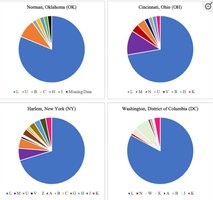
OH had the highest percentage of African (L) haplogroups.
DC had the highest percentage of Native American haplogroups.
NY had the highest percentage of European haplogroups.
Diversity of African mtDNA Haplogroups
The diversity of L-haplogroups among African Americans reflects the complex maternal ancestry within the population.
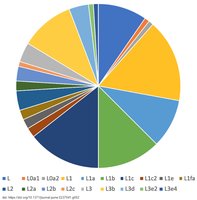
Multiple subclades of the L haplogroup were identified, indicating diverse African maternal origins.
Self-Identified Race/Ethnicity vs. Genetic Evidence
Native American and European Ancestry Among Mixed Individuals
There is often a discrepancy between self-identified ancestry and genetic evidence. Many individuals who identified as "mixed" showed little Native American maternal ancestry, and only a few had significant Native American or European global ancestry.
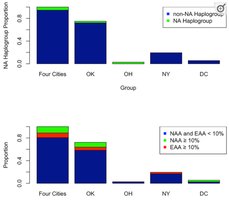
Most mixed participants had more European than Native American ancestry.
Few participants had ≥10% Native American or European ancestry, despite self-identification as mixed.
Implications for Genetics and Biomedical Research
Limitations of Using Skin Color as a Proxy for Ancestry
Skin color is an imprecise proxy for genetic ancestry and can mask important genetic and social heterogeneity within populations. Genetic ancestry provides a more accurate framework for understanding biological variation and disease risk.
Genetic ancestry estimates using AIMs reveal fluidity and variation within traditional racial groups.
Biomedical research should consider both genetic ancestry and local historical/social context rather than relying solely on skin pigmentation or self-identified race.
Summary Table: Key Findings
Variable | Key Finding |
|---|---|
Skin Color | Correlated with West African ancestry; varies by region and sex |
Genetic Ancestry | Significant regional variation; not always aligned with self-identified race |
Social Attainment | Complex relationship with skin color and ancestry; influenced by local history |
mtDNA Haplogroups | Diverse African lineages; regional differences in European and Native American haplogroups |
Conclusion
The study demonstrates the heterogeneity of the U.S. Black population in terms of genetic ancestry, skin color, and social attainment. It highlights the importance of considering both genetic and sociocultural factors in genetics research and cautions against treating populations as monolithic based on physical traits or self-identification alone.
