 뒤로
뒤로Genetics of Bacteria: Horizontal Gene Transfer and Recombinant DNA Technology
스터디 가이드 - 스마트 노트
 자료에 맞춘 맞춤형 노트, 핵심 정의, 예시, 맥락을 확장해 제공합니다.
Genetics of Bacteria
Introduction to Bacterial Genetics
Bacteria are single-celled prokaryotic organisms that exhibit remarkable genetic diversity and adaptability. Their genetic systems are simpler than those of eukaryotes, yet they possess unique mechanisms for genetic exchange and evolution.
Small cell size: Typically around 1 μm in diameter.
Small genomes: Most bacterial genomes are approximately 5 Mb (megabases).
Rapid generation time: Some bacteria can divide every 20 minutes under optimal conditions.
Asexual reproduction: Bacteria primarily reproduce by binary fission.
Prokaryotic cell structure: Lack a nucleus and membrane-bound organelles.
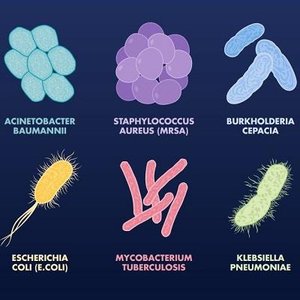
Examples: Escherichia coli, Staphylococcus aureus, Mycobacterium tuberculosis, and others are important model organisms and pathogens.
Bacterial Genome Organization
Genome Size and Structure
Bacterial genomes are typically composed of a single, circular chromosome, though some species may have linear chromosomes or multiple replicons. In addition to the main chromosome, bacteria often harbor plasmids—small, circular DNA molecules that replicate independently.
Genome size: Ranges from less than 1 Mb to over 10 Mb, depending on the species.
Plasmids: Extrachromosomal DNA elements that can carry genes for antibiotic resistance, virulence, and metabolic functions.
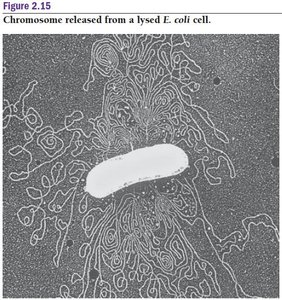
Comparison: Human chromosomes are linear and much larger, containing billions of base pairs, while bacterial chromosomes are compact and efficient.
Bacterial Genome Size Comparison
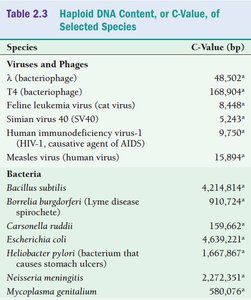
Bacterial genomes are much smaller than those of eukaryotes and viruses. The table below compares the haploid DNA content (C-value) of selected species.
Species | C-Value (bp) |
|---|---|
Bacillus subtilis | 4,214,814 |
Borrelia burgdorferi | 910,724 |
Escherichia coli | 4,639,221 |
Helicobacter pylori | 1,667,867 |
Mycoplasma genitalium | 580,076 |
Horizontal Gene Transfer in Bacteria
Mechanisms of Horizontal Gene Transfer
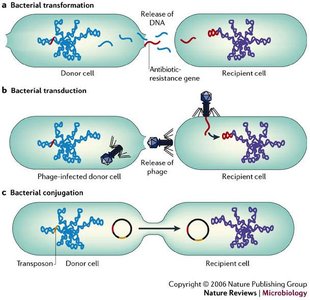
Horizontal gene transfer (HGT) is the movement of genetic material between organisms other than by descent from parent to offspring. HGT is a major driver of bacterial evolution and adaptation, allowing for the rapid acquisition of new traits such as antibiotic resistance.
Transformation: Uptake of free DNA from the environment by a competent bacterial cell.
Transduction: Transfer of DNA from one bacterium to another via bacteriophages (viruses that infect bacteria).
Conjugation: Direct transfer of DNA from one bacterial cell to another through cell-to-cell contact, often mediated by plasmids.
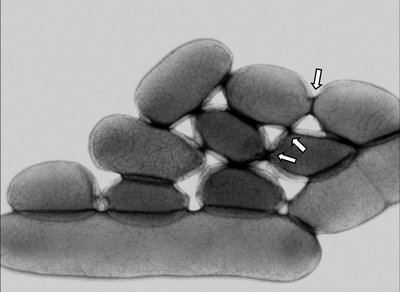
Example: The spread of antibiotic resistance genes among pathogenic bacteria is often facilitated by HGT.
Plasmids and Their Role in Gene Transfer
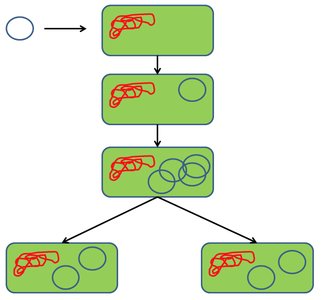
Plasmids are small, circular DNA molecules that exist independently of the bacterial chromosome. They often carry genes that confer selective advantages, such as antibiotic resistance, and can be transferred between bacteria via conjugation.
Self-replicating: Plasmids have their own origin of replication.
Multiple copies: A single cell may contain many copies of a plasmid.
Heritability: Plasmids are passed on to daughter cells during cell division.
Recombinant DNA Technology in Bacteria
Restriction Enzymes and DNA Cloning
Restriction enzymes are proteins that recognize specific DNA sequences and cut the DNA at or near these sites. They are essential tools in molecular genetics for creating recombinant DNA molecules.
Restriction sites: Short, palindromic DNA sequences recognized by restriction enzymes.
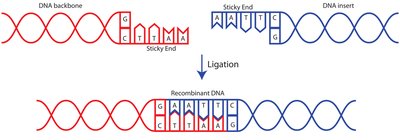
Sticky ends: Single-stranded overhangs created by staggered cuts, facilitating the ligation of DNA fragments.
DNA ligase: Enzyme that joins DNA fragments by forming phosphodiester bonds.
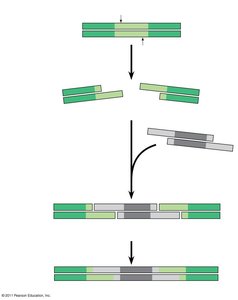
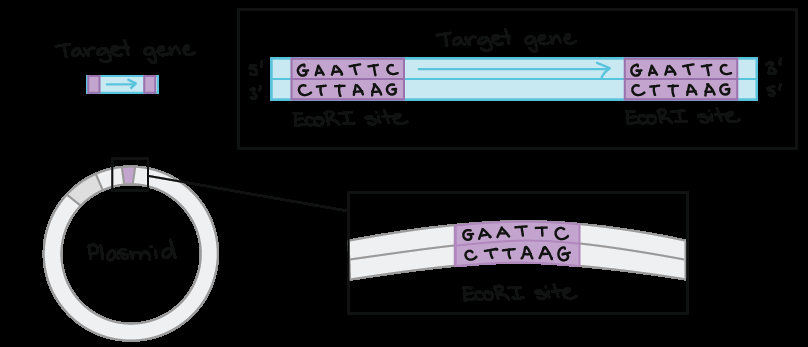
Example: The EcoRI enzyme recognizes the sequence GAATTC and cuts between G and A, producing sticky ends.
Creating Recombinant Plasmids
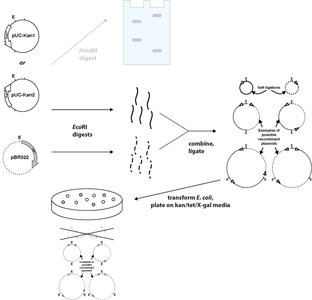
To create recombinant DNA, both the plasmid vector and the DNA fragment of interest are cut with the same restriction enzyme, generating compatible ends. The fragments are then joined using DNA ligase.
Digest plasmid and insert: Both are cut with the same restriction enzyme to ensure compatible ends.
Ligation: DNA ligase seals the nicks, forming a stable recombinant molecule.
Transformation: The recombinant plasmid is introduced into a bacterial host for propagation and selection.
Directionality of Insertion
Because restriction sites are palindromic, the target gene can insert in either orientation. To control the direction of insertion, asymmetrically located restriction sites are used on both the vector and the insert.
Asymmetric sites: Use two different restriction enzymes to ensure directional cloning.
Screening: Colonies are screened to determine the orientation of the insert.
Screening and Selection of Recombinant Bacteria
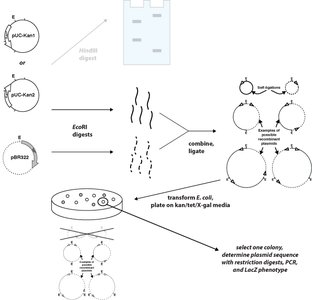
After transformation, bacteria are plated on selective media to identify colonies containing recombinant plasmids. Further analysis, such as restriction digests, PCR, or phenotypic assays (e.g., lacZ), is used to confirm the presence and orientation of the insert.
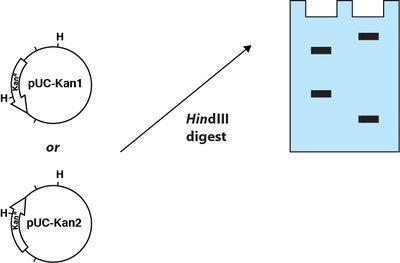
Agarose gel electrophoresis: Separates DNA fragments by size to verify successful cloning.
Antibiotic selection: Only bacteria with the plasmid survive on selective media.
Phenotypic screening: Reporter genes (e.g., lacZ) can indicate successful insertion.
Summary Table: Key Concepts in Bacterial Genetics
Concept | Description | Example/Application |
|---|---|---|
Horizontal Gene Transfer | Movement of genetic material between bacteria | Antibiotic resistance spread |
Plasmid | Small, circular DNA molecule | pBR322, pUC19 |
Restriction Enzyme | Protein that cuts DNA at specific sites | EcoRI, HindIII |
Recombinant DNA | DNA molecule formed by joining DNA from different sources | Genetic engineering |
Transformation | Uptake of free DNA by bacteria | Griffith's experiment |
Additional info: The study of bacterial genetics provides foundational knowledge for biotechnology, medicine, and evolutionary biology. Techniques such as recombinant DNA technology have revolutionized genetic engineering and synthetic biology.
