 뒤로
뒤로Genetics Problem Set: Mutation – Causes & Consequences (Step-by-Step Guidance)
스터디 가이드 - 스마트 노트
 자료에 맞춘 맞춤형 노트, 핵심 정의, 예시, 맥락을 확장해 제공합니다.
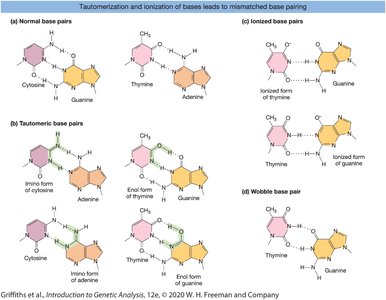
Q6. In Figure 15-6, when a G shifts to its rare enol form, what nucleotide can the DNA polymerase add rather than a C? Also, following additional rounds of DNA replication, wild-type cells have a G·C base pair; what base pair will mutant cells have?
Background
Topic: Tautomerization and Mutagenesis
This question tests your understanding of how rare tautomeric forms of DNA bases can lead to mispairing during replication, resulting in mutations.
Key Terms and Concepts:
Tautomer: An alternative chemical form of a base that can pair differently than the common form.
Enol form of guanine: A rare form that can pair with a base other than cytosine.
Base pair substitution: A mutation where one base pair is replaced by another.
Step-by-Step Guidance
Examine the normal base pairing: Guanine (G) normally pairs with cytosine (C) via three hydrogen bonds.
Consider what happens when G shifts to its enol form: The enol form changes the hydrogen bonding pattern, allowing it to pair with a different base.
Identify which base the enol form of G can pair with during DNA replication (refer to the figure for the specific pairing).
Think about what happens in the next round of replication: The mispaired base will serve as a template, leading to a permanent base pair change in the DNA sequence.
Set up the sequence of events: Start with a G·C pair, then show the mispairing, and finally, what base pair results after two rounds of replication.
Try solving on your own before revealing the answer!
Final Answer:
When guanine shifts to its rare enol form, DNA polymerase can add thymine (T) instead of cytosine (C). After two rounds of replication, the original G·C base pair is replaced by an A·T base pair in the mutant cells.
This is an example of a transition mutation caused by tautomeric shift.
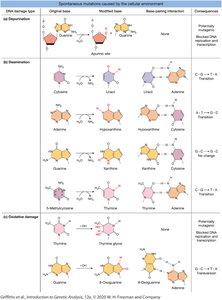
Q9. In Fig. 15-9, oxidation of guanine to 8-oxoguanine leads to a G·C → T·A transversion after DNA replication. Write out the DNA replication steps that lead to the base transversion.
Background
Topic: Oxidative DNA Damage and Transversion Mutations
This question examines how chemical modification of bases (specifically guanine oxidation) can cause mispairing and result in a transversion mutation.
Key Terms and Concepts:
8-oxoguanine: An oxidized form of guanine that mispairs with adenine.
Transversion: A mutation where a purine is replaced by a pyrimidine or vice versa (e.g., G·C to T·A).
Step-by-Step Guidance
Start with a normal G·C base pair in the DNA.
Describe the chemical modification: Guanine is oxidized to 8-oxoguanine.
Explain how 8-oxoguanine pairs with adenine during DNA replication.
In the next round of replication, adenine will pair with thymine, completing the transversion.
Set up the sequence of base pairs through two rounds of replication, showing the change from G·C to T·A.
Try solving on your own before revealing the answer!
Final Answer:
Oxidation of guanine to 8-oxoguanine causes it to pair with adenine instead of cytosine. In the next replication, adenine pairs with thymine, resulting in a G·C to T·A transversion.
This is a classic example of a transversion mutation caused by oxidative DNA damage.
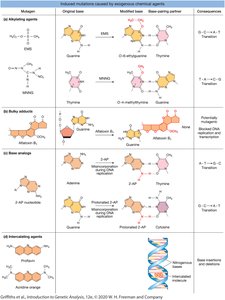
Q10. In Figure 15-10, the reaction of EMS with guanine generates O-6-ethylguanine, which leads to a G·C → A·T transition. Write out the DNA replication steps that lead to the base transition.
Background
Topic: Alkylation-Induced Mutations
This question focuses on how alkylating agents like EMS modify DNA bases, causing mispairing and transition mutations.
Key Terms and Concepts:
EMS (ethyl methanesulfonate): A chemical mutagen that adds ethyl groups to DNA bases.
O-6-ethylguanine: An alkylated form of guanine that mispairs with thymine.
Transition: A mutation where a purine is replaced by another purine or a pyrimidine by another pyrimidine (e.g., G·C to A·T).
Step-by-Step Guidance
Begin with a normal G·C base pair in the DNA.
Describe the chemical reaction: EMS modifies guanine to O-6-ethylguanine.
Explain how O-6-ethylguanine pairs with thymine during DNA replication.
In the next round of replication, thymine will pair with adenine, completing the transition.
Set up the sequence of base pairs through two rounds of replication, showing the change from G·C to A·T.
Try solving on your own before revealing the answer!
Final Answer:
O-6-ethylguanine pairs with thymine instead of cytosine. In the next replication, thymine pairs with adenine, resulting in a G·C to A·T transition mutation.
This is a typical transition mutation caused by alkylating agents like EMS.
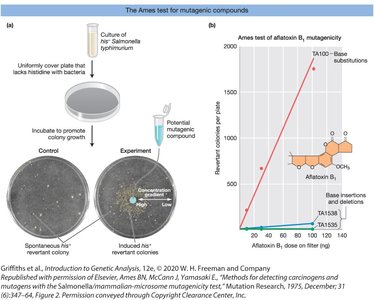
Q12. In Figure 15-12, what types of DNA damage are likely to have led to mutations in spontaneous his+ revertant colonies?
Background
Topic: Spontaneous Mutations and DNA Damage
This question asks you to connect types of spontaneous DNA damage to the reversion of a his- mutation to his+ in bacteria.
Key Terms and Concepts:
Spontaneous mutation: A mutation that occurs naturally without external mutagens.
Revertant colony: A bacterial colony that has regained the ability to synthesize histidine (his+).
Step-by-Step Guidance
Recall the types of spontaneous DNA damage (e.g., depurination, deamination, tautomeric shifts, oxidative damage).
Consider which types of damage can cause base substitutions or frameshifts that might restore gene function.
Think about how these mutations could revert a his- mutation to his+ (e.g., by correcting a previous mutation or creating a compensatory change).
Try solving on your own before revealing the answer!
Final Answer:
Types of DNA damage likely include spontaneous base substitutions (from tautomeric shifts or deamination), small insertions or deletions, or oxidative damage that restores the reading frame or corrects the original mutation, allowing the his+ phenotype to reappear.
Q22. The substitution shown seems to have created a stop codon. What additional information do you need to be confident that it has done so?
Background
Topic: Mutation Effects on Protein Coding
This question tests your understanding of how nucleotide substitutions can create stop codons (nonsense mutations) and what information is needed to confirm this effect.
Key Terms and Concepts:
Stop codon: A codon that signals termination of translation (UAA, UAG, UGA).
Reading frame: The way nucleotides are grouped into codons for translation.
Step-by-Step Guidance
Identify the codon affected by the substitution in the sequence.
Determine the reading frame to see which triplet is being translated.
Check if the new codon matches any of the three stop codons in the genetic code.
Consider whether the sequence is in the coding region and if the reading frame is correct.
Try solving on your own before revealing the answer!
Final Answer:
You need to know the reading frame and whether the sequence is in the coding region. Only then can you confirm if the substitution creates a stop codon (UAA, UAG, or UGA) in the mRNA.
Q23. Can a missense mutation of proline to histidine be made with a G·C → A·T transition-causing mutagen? What about a proline-to-serine missense mutation? Refer to the genetic code in Figure 9-8.
Background
Topic: Missense Mutations and the Genetic Code
This question asks you to use the genetic code to determine if specific amino acid changes can result from a G·C → A·T transition.
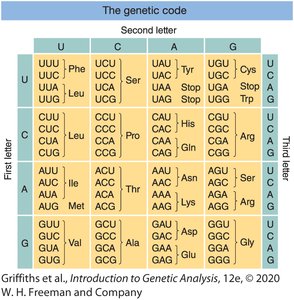
Key Terms and Concepts:
Missense mutation: A nucleotide change that results in a different amino acid.
Transition: A purine-to-purine or pyrimidine-to-pyrimidine substitution (e.g., G·C to A·T).
Step-by-Step Guidance
Identify the codons for proline, histidine, and serine using the genetic code table.
Determine which base changes (G·C to A·T) would convert a proline codon to a histidine or serine codon.
Check if such a transition is possible for each amino acid change.
Try solving on your own before revealing the answer!
Final Answer:
A G·C → A·T transition can convert a proline codon (e.g., CCA, CCC, CCG, or CCT) to a serine codon (e.g., TCA, TCC, TCG, TCT) but not to a histidine codon (CAT or CAC). Therefore, a proline-to-serine missense mutation is possible with this transition, but not proline-to-histidine.
Q28. Where within a gene might trinucleotide repeat expansion occur, and how might expansion at those sites lead to disease?
Background
Topic: Trinucleotide Repeat Expansion Disorders
This question explores the locations of repeat expansions in genes and their consequences for gene function and disease.
Key Terms and Concepts:
Trinucleotide repeat: A sequence of three nucleotides repeated multiple times in a gene.
Repeat expansion: An increase in the number of repeats, which can disrupt gene function.
Step-by-Step Guidance
Identify common locations of trinucleotide repeats (e.g., coding region, 5' UTR, 3' UTR, introns).
Explain how expansion in the coding region can alter the protein sequence (e.g., polyglutamine diseases).
Describe how expansion in non-coding regions can affect gene expression or mRNA processing.
Try solving on your own before revealing the answer!
Final Answer:
Trinucleotide repeat expansion can occur in coding regions (leading to abnormal proteins) or in regulatory/non-coding regions (affecting gene expression or mRNA processing). Expansion at these sites can cause diseases such as Huntington's disease or fragile X syndrome by disrupting normal gene function.
Q31. Why are many chemicals that test positive by the Ames test also classified as carcinogens?
Background
Topic: Mutagenicity and Carcinogenicity
This question connects the results of the Ames test (which detects mutagens) to the classification of chemicals as carcinogens (cancer-causing agents).
Key Terms and Concepts:
Ames test: A test that measures the mutagenic potential of chemicals using bacteria.
Carcinogen: A substance capable of causing cancer.
Step-by-Step Guidance
Recall that the Ames test detects chemicals that cause mutations in DNA.
Understand that many cancers are caused by mutations in genes that control cell growth.
Explain why chemicals that are mutagenic in the Ames test are likely to also be carcinogenic in animals or humans.
Try solving on your own before revealing the answer!
Final Answer:
Many chemicals that test positive in the Ames test are classified as carcinogens because mutagenic chemicals can cause mutations in genes that regulate cell division, leading to uncontrolled cell growth and cancer.
Q32. Differentiate between the elements of the following pairs:
Background
Topic: Types of Mutations
This question asks you to distinguish between different types of mutations and their effects on gene function.
Key Terms and Concepts:
Transition vs. Transversion: Types of base substitutions.
Synonymous vs. Neutral mutation: Effects on protein sequence and function.
Missense vs. Nonsense mutation: Effects on the encoded protein.
Frameshift vs. Nonsense mutation: Types of mutations that disrupt translation.
Step-by-Step Guidance
Define each term in the pairs (e.g., transition, transversion, etc.).
Compare and contrast the effects of each mutation type on DNA and protein sequence.
Provide examples where possible to illustrate the differences.
Try solving on your own before revealing the answer!
Final Answer:
Transitions: Purine-to-purine or pyrimidine-to-pyrimidine substitutions. Transversions: Purine-to-pyrimidine or vice versa.
Synonymous mutations: Change the codon but not the amino acid. Neutral mutations: Do not affect protein function (may or may not change the amino acid).
Missense mutations: Change one amino acid to another. Nonsense mutations: Change a codon to a stop codon, truncating the protein.
Frameshift mutations: Insertions or deletions that alter the reading frame. Nonsense mutations: Introduce a premature stop codon.
Previous Exam Q1. Which of the following is/are not possible? (SELECT ALL THAT APPLY)
Background
Topic: Mutation Types and Genomic Regions
This question tests your understanding of where different types of mutations can occur within a gene or genome.
Key Terms and Concepts:
Missense mutation: Changes an amino acid in the coding region.
Nonsense mutation: Creates a stop codon in the coding region.
Frameshift mutation: Alters the reading frame, usually in coding regions.
Indel mutation: Insertion or deletion of bases.
Intron, exon, regulatory region: Different parts of a gene.
Step-by-Step Guidance
Review the definitions of each mutation type and where they can occur (coding vs. non-coding regions).
Consider whether each mutation type can have an effect in the specified region (e.g., missense in an intron).
Eliminate options that are possible, and focus on those that are not possible based on your understanding.
Try solving on your own before revealing the answer!
Final Answer:
a) A missense mutation in an intron is not possible (missense mutations occur in coding regions). c) A frameshift mutation in a regulatory region is not possible (frameshifts affect coding sequences).
Previous Exam Q2. You have isolated a new mutant allele of the Drosophila mid gene, and you run a Northern blot on heterozygous individuals to look at the mid mRNA. Which of the following types of mutations in the new mutant allele could explain your observations? (SELECT ALL THAT APPLY)
Background
Topic: Effects of Mutations on mRNA
This question asks you to consider which types of mutations can affect mRNA levels or size as detected by Northern blot.
Key Terms and Concepts:
Northern blot: Technique to detect RNA (mRNA) size and abundance.
Missense, frameshift, transversion, nonsense, deletion: Types of mutations with different effects on mRNA.
Step-by-Step Guidance
Recall which mutations can affect mRNA size or stability (e.g., nonsense, frameshift, deletion).
Consider whether each mutation type would be detectable by Northern blot (e.g., missense and transversion usually do not affect mRNA size).
Select all mutation types that could explain altered mRNA on a Northern blot.
Try solving on your own before revealing the answer!
Final Answer:
b) Frameshift, d) Nonsense, and e) Deletion could explain changes in mRNA detected by Northern blot.
Previous Exam Q3. After mutagen treatment, a molecule of 2-aminopurine (an adenine analogue) incorporates into DNA. During replication, the 2-AP protonates and, in this form, bonds like guanine. The mutational event caused by this will be: (CHOOSE ONE)
Background
Topic: Base Analogue Mutagenesis
This question tests your understanding of how base analogues like 2-aminopurine can cause mutations by mispairing during replication.
Key Terms and Concepts:
2-aminopurine (2-AP): A base analogue that can pair with thymine or, when protonated, with cytosine (like guanine).
Base substitution: Replacement of one base pair with another.
Step-by-Step Guidance
Understand that 2-AP can pair with thymine (like adenine) or with cytosine (like guanine when protonated).
Consider what happens if 2-AP is incorporated opposite thymine, then protonates and pairs with cytosine in the next round.
Determine which base pair change results from this process (A·T to G·C, etc.).
Try solving on your own before revealing the answer!
Final Answer:
a) A·T to G·C is the mutational event caused by 2-aminopurine incorporation and mispairing.
